Why Your Cold Email Follow Up Sequence Matters
For instance, a well-crafted cold email follow up sequence is the difference between a 2% reply rate and a 15% reply rate. In fact, most deals happen after the third touchpoint — here is exactly how to build yours.
In addition, you send one cold email. In particular, no reply. Therefore, you assume the prospect is not interested and move on. In other words, that single decision is costing you roughly 80% of the meetings you could be booking.
Research from the RAIN Group consistently shows that it takes an average of 8 touchpoints to generate a meeting or conversion with a new prospect. Additionally, the National Sales Executive Association found that 80% of sales require 5 or more follow-up contacts, yet 44% of salespeople give up after just one follow-up. In the UAE B2B market specifically, where decision-makers receive 50-100+ business emails daily and often travel between Dubai, Abu Dhabi, Riyadh, and London, your single email is competing against enormous noise.
Here is what the data from campaigns we have analyzed across the Dubai market looks like:
HubSpot follow-up research shows that 80% of sales require at least five follow-ups, yet 44% of salespeople give up after just one.
- Email 1: 3-5% reply rate
- Email 2: 4-6% reply rate (cumulative: 7-11%)
- Email 3: 3-5% reply rate (cumulative: 10-16%)
- Email 4: 2-4% reply rate (cumulative: 12-20%)
- Email 5: 2-3% reply rate (cumulative: 14-23%)
Furthermore, the pattern is clear: a cold email follow up sequence of emails 2 through 5 generates more replies than email 1 alone. Accordingly, your follow-up sequence is not annoying — it is where the majority of your results come from. Additionally, the question is not whether to follow up, but how to do it without sounding desperate, repetitive, or irrelevant.
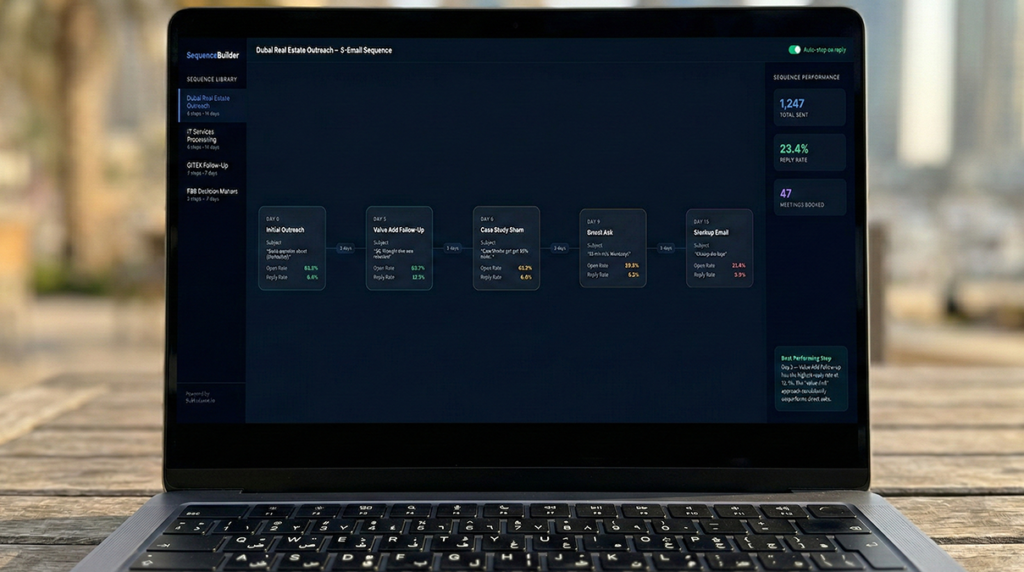
The 5-Email Sequence Framework (Day 0, 2, 5, 9, 14)
Timing matters as much as content. Send follow-ups too quickly and you seem pushy. Wait too long and the prospect forgets your first email entirely. After testing dozens of cadences with Dubai-based B2B campaigns, this spacing consistently produces the best results:
- Email 1 (Day 0): The opening — your first contact
- Email 2 (Day 2): The value-add follow-up — provide something useful
- Email 3 (Day 5): The case study share — prove you deliver results
- Email 4 (Day 9): The direct ask — be explicit about what you want
- Email 5 (Day 14): The breakup email — give them an easy out
In fact, this 14-day sequence gives you enough touchpoints to build familiarity without overwhelming the prospect. Additionally, the gaps between emails widen as the sequence progresses — this is deliberate. Early follow-ups benefit from proximity to the original email. Later follow-ups benefit from creating a sense of persistence without pressure.
Notably, one critical note for the UAE market: account for Thursday-Friday weekends (for government-connected businesses) and Friday-Saturday weekends (for DIFC and many private sector companies). If day 5 falls on a Friday, push that email to Saturday or Sunday depending on your prospect’s likely schedule.
Email 1: The Opening (Day 0)
Specifically, your opening email does the heaviest lifting of the entire sequence. Notably, it establishes who you are, why you are reaching out, and what value you bring — all in under 125 words. Furthermore, we covered the complete anatomy of a high-performing cold email opener in our cold email templates guide, including 7 proven templates specifically adapted for Dubai B2B audiences.
Furthermore, the essentials for your opener:
- Personalized subject line referencing the recipient’s company, role, or industry (see our subject line guide for proven formats)
- Opening line that demonstrates you have researched their business — not a generic compliment, but a specific observation
- One clear value proposition tied to a problem they likely face
- A soft call-to-action (asking a question, not demanding a meeting)
- Total length: 75-125 words
Specifically, your opener sets the tone for every follow-up that comes after it. If your first email is generic and salesy, your follow-ups will be ignored regardless of how well-written they are. Invest the time to personalize email 1 — the ROI compounds across the entire sequence.
Email 2: The Value-Add Follow-Up (Day 2)
Email 2 is where most senders fail. The typical follow-up sounds like this: “Just following up on my previous email…” or “Did you get a chance to read my email?” These add zero value and signal to the prospect that you have nothing new to offer.
Instead, email 2 should provide something genuinely useful — a resource, insight, or data point that the prospect can benefit from even if they never reply. As a result, this shifts the dynamic from “salesperson chasing a lead” to “knowledgeable professional sharing value.”
Template: The Value-Add Follow-Up
Subject: [specific resource] for [company name]
Hi [First Name],
I shared a thought on [topic from email 1] a couple of days ago. Whether or not that resonated, I wanted to pass along something that might be useful regardless.
[Insert one of: a relevant industry statistic, a short analysis of a trend affecting their sector, a link to a genuinely useful resource, or a quick benchmark comparison]
For context, we have been working with [number] [industry] companies in [Dubai/UAE] on [specific outcome], and this particular insight keeps coming up.
Worth a 15-minute conversation to explore if this applies to [company name]?
[Your name]
Why this works in Dubai: decision-makers in the UAE B2B market are relationship-driven. Demonstrating generosity with your expertise — before asking for anything in return — aligns with the business culture of building trust before transacting. Accordingly, your value-add email says “I am invested in your success” rather than “I want your money.”
Value-Add Ideas for the UAE Market
- A Dubai-specific market statistic relevant to their industry (“Dubai’s real estate transactions hit AED 761 billion in 2025 — here is what that means for property tech vendors”)
- A competitive insight (“3 things your top competitors in [industry] are doing differently in the GCC market”)
- A regulatory update (“New MOHRE requirement affecting [industry] companies with 50+ employees”)
- A benchmark comparison (“How your industry’s average [metric] in the UAE compares to global averages”)
Email 3: The Case Study Share (Day 5)
By day 5, your prospect has seen your name twice. Consequently, they may have opened your emails. Consequently, they may have even clicked a link. But they have not replied — which usually means they are not convinced that you can deliver on your claims. Email 3 addresses this with proof.
A case study email is not a PDF attachment. Notably, it is a 3-4 sentence summary of a specific result you achieved for a similar company, embedded directly in the email body.
Template: The Case Study Share
Subject: How [similar company type] increased [metric] by [number]%
Hi [First Name],
Quick example that might be relevant to [company name]:
Additionally, we worked with a [industry] company in [Dubai/Abu Dhabi/UAE] that was struggling with [specific problem]. Within [timeframe], they [specific measurable result].
Furthermore, the key change was [one specific thing you did differently — not a vague “our platform” but an actual tactic or approach].
[Company name] looks like it might face a similar situation based on [specific observation about their business]. Happy to walk through the details in a quick call.
Would [specific day] or [specific day] work for 15 minutes?
[Your name]
Case Study Tips for UAE Audiences
- Reference the GCC or UAE market specifically — global case studies carry less weight with Dubai-based decision-makers
- Use AED figures where possible, or at least contextualize USD figures for the local market
- Mention the company type (free zone company, mainland LLC, multinational regional HQ) to increase relatability
- If confidentiality prevents naming the client, describe them specifically enough to be recognizable (“a mid-size fintech company in DIFC with 120 employees”)
Email 4: The Direct Ask (Day 9)
In addition, you have provided value. Therefore, you have shared proof. Now it is time to be direct. Email 4 drops the soft approach and makes a clear, specific ask. Many B2B senders are uncomfortable with directness, but in the UAE market, clarity is respected — especially at the senior level.
Template: The Direct Ask
Subject: Quick question, [First Name]
Hi [First Name],
I have reached out a few times about [core topic — keep it to 5-7 words]. I want to be respectful of your time, so I will be direct:
Would you be open to a 15-minute call this week to explore whether [specific outcome you deliver] is a priority for [company name] right now?
If the timing is not right, no problem at all — just let me know and I will follow up in [specific future timeframe, e.g., Q3].
If this is not your area, could you point me to the right person on your team?
[Your name]
Three elements make this email effective:
- Acknowledging previous emails: “I have reached out a few times” shows self-awareness without apologizing
- Providing an easy “no”: “If the timing is not right” gives them permission to decline without guilt — and some prospects will reply with “try me in Q3,” which is a warm lead
- The referral ask: “Could you point me to the right person” often generates a reply even from prospects who are not the right contact — and an internal referral is worth more than any cold email
Email 5: The Breakup Email (Day 14)
The breakup email is the most counterintuitive email in the sequence — and often the highest-performing. By explicitly telling the prospect that you will stop emailing them, you create a psychological trigger: the fear of missing out on something they might actually need.
Template: The Breakup Email
Subject: Should I close your file?
Hi [First Name],
I have sent a few messages about [core topic] over the past two weeks and have not heard back. In other words, that usually means one of three things:
1. You are happy with how you currently handle [area].
2. It is not a priority right now.
3. You have been busy and this fell through the cracks.If it is #1 or #2, I will stop reaching out — no hard feelings. If it is #3, I am happy to reconnect whenever it makes sense.
Either way, just reply with 1, 2, or 3 and I will know how to proceed.
[Your name]
Why the breakup email works:
- It is the easiest email in the sequence to respond to (just type a number)
- It demonstrates respect for the prospect’s time and inbox
- It reframes the dynamic: you are not chasing them, you are offering closure
- Prospects who respond with “3” are now warm leads who have explicitly asked you to follow up
In the Dubai market, breakup emails consistently generate reply rates 2-3x higher than email 4. Furthermore, we have seen sequences where the breakup email alone generated 40% of total replies. The numbered response format works particularly well with senior executives who process emails quickly on mobile devices.
Timing Science: Best Days and Times for Dubai B2B Email
Your follow-up sequence can be perfectly written and still underperform if your timing is wrong. Dubai’s B2B market has specific timing patterns that differ from Western markets:
Best days to send:
- Tuesday and Wednesday: Consistently the highest open and reply rates across Dubai B2B campaigns. Decision-makers have cleared their Monday backlog and are not yet winding down for the weekend.
- Sunday: Strong performer in the UAE market because it is the first working day of the week for many businesses. Emails sent Sunday morning often get processed as part of the morning email review.
- Monday: Good for follow-ups (not first touches) because prospects who opened your previous email over the weekend may be ready to respond.
Worst days to send:
- Thursday after 2 PM: Many professionals begin winding down for the weekend. Government-connected businesses may close early.
- Friday: Lowest open rates of the week. The UAE Friday is equivalent to the Western Sunday — a day off for most.
- Saturday: Mixed results. Evidently, some private sector companies operate on Saturdays, but open rates are 30-40% lower than Tuesday-Wednesday.
Best Times to Send in Gulf Standard Time
- 8:00-9:30 AM Gulf Standard Time: Catches decision-makers during their morning email review. As a result, this is the single highest-performing send window in our data.
- 1:00-2:00 PM GST: Post-lunch email check. Secondary peak, particularly for follow-up emails.
- Avoid after 5:00 PM GST: Open rates drop significantly. Emails sent in the evening are buried by morning.
Account for Ramadan timing if your campaign runs during the holy month. Business hours shift, with many companies operating from 9 AM to 2 PM. Adjust your send times to 9:00-10:00 AM during Ramadan for the best results.
Your follow-up sequence only works if your emails are actually reaching the inbox. If you are experiencing deliverability issues, address them before scaling your sequence. Our email warmup guide covers everything you need — your follow-ups only work if they land in the inbox.
Multi-Channel Follow-Up: Adding LinkedIn and WhatsApp
Email alone is not enough for the Dubai B2B market. Decision-makers in the UAE are exceptionally active on LinkedIn and WhatsApp — often more responsive on these channels than email. For example, a multi-channel sequence that combines email with LinkedIn and WhatsApp touches can increase your overall reply rate by 40-60%.
Here is how to integrate additional channels into your 5-email sequence:
Day 1 (after Email 1): Send a LinkedIn connection request. Do not pitch in the connection note. Use a simple, curiosity-driven message: “Hi [First Name], I noticed we are both in the [industry] space in Dubai. Would be great to connect.” Accept that 30-40% will accept — and now they will see your name in their LinkedIn feed, building familiarity.
Adding LinkedIn to Your Sequence
Day 4 (between Email 2 and 3): If they accepted your LinkedIn request, send a brief LinkedIn message referencing your email: “Hi [First Name], I shared a quick [industry] insight with you by email earlier this week. Thought it might be useful for [company name]. Let me know if you had a chance to look at it.” Keep it under 50 words.
Day 7 (between Email 3 and 4): If you have the prospect’s WhatsApp number (common in the UAE where business cards often include WhatsApp), send a very brief message: “Hi [First Name], [Your name] here from [Company]. I sent you a quick case study by email that I think is relevant to [company name]. Happy to discuss whenever it suits.” WhatsApp messages in the UAE have 90%+ open rates.
WhatsApp Guidelines for UAE B2B
- Only use WhatsApp if you have a legitimate business context for having their number (business card, website listing, directory)
- Never send marketing content or long messages via WhatsApp — keep it conversational and brief
- Respect “read but no reply” as a soft no. Do not send multiple WhatsApp follow-ups.
- WhatsApp Business API is the compliant option for scaled outreach. Personal WhatsApp should only be used for individual, personalized messages.
When to Stop: Reading the Signals
Persistence works. Pestering does not. Knowing when to stop emailing a prospect is as important as knowing how to follow up. Here are the signals to watch for:
Hard stops (cease contact immediately):
- The prospect replies asking you to stop emailing them
- They click the unsubscribe link
- Their email bounces with a permanent delivery failure (hard bounce)
- They mark your email as spam
- They block you on LinkedIn or WhatsApp
Soft stops (pause and reassess):
- Five emails sent with zero opens — your emails are likely going to spam. Fix your deliverability before continuing. See our email warmup guide.
- Five emails sent with opens but zero replies — they are seeing your emails but not interested enough to respond. Move them to a quarterly nurture cadence (one email every 90 days with genuine value, no pitch).
- They reply with “not now” or “not interested” — respect the response. Add them to a 6-month re-engagement list with a single check-in email.
- They refer you to a colleague — stop emailing the original contact and start a fresh sequence with the referred person (mentioning the referral).
Continue Signals: When Your Sequence Is Working
Continue signals (these mean your sequence is working):
- Opening multiple emails in the sequence — engagement is there, they just have not committed to a reply yet
- Clicking links in your emails — they are interested in your content
- Viewing your LinkedIn profile after receiving an email — they are researching you
- Forwarding your email to a colleague (visible in some email tracking tools) — they are discussing you internally
For the Dubai market specifically, factor in travel patterns. Many UAE executives travel frequently to Saudi Arabia, Europe, and Asia. A two-week silence might simply mean they were in Riyadh for a conference. Check LinkedIn activity to gauge whether they are active but ignoring you, or simply offline.
The bottom line: a well-executed cold email follow up sequence over 14 days, supported by LinkedIn and WhatsApp touches, will generate 3x more meetings than a single email followed by silence. But it only works with accurate contact data. Bad emails do not get better with repetition — they just bounce five times instead of once. Start with verified leads, and your sequence has a foundation worth building on.
This article is part of our comprehensive B2B Lead Generation in Dubai: The 2026 Playbook — the complete guide to generating pipeline in the UAE market.