B2B Lead Generation Dubai: The Market Landscape
B2B lead generation in Dubai operates by different rules than Western markets. As a result, this playbook covers every B2B lead generation Dubai strategy that actually works — from cold email to WhatsApp to trade shows.
Dubai’s B2B market crossed $48 billion in cross-border trade services in 2025, and 2026 is shaping up even bigger. Additionally, the D33 agenda — Dubai’s plan to double GDP by 2033 — has injected fresh capital into every sector from logistics to fintech. If you’re selling B2B in this market, you’re competing in one of the fastest-moving commercial environments on the planet.
Here’s what matters for lead generation specifically:
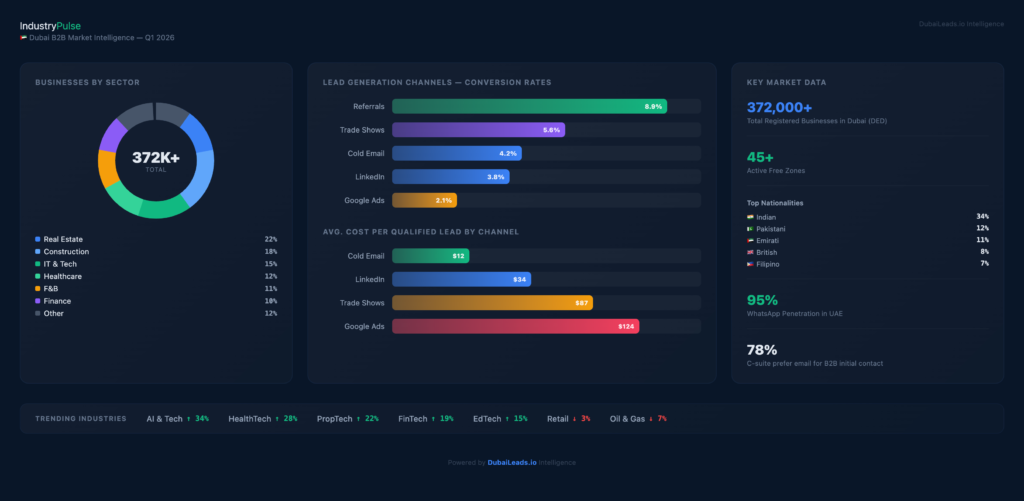
- 45,000+ new trade licenses were issued in Dubai in 2025 alone. That’s 45,000 new companies that need software, office space, legal services, marketing, staffing, and everything else.
- Free zones now house over 60,000 companies across 30+ zones (DMCC, DIFC, DAFZA, JAFZA being the largest). Specifically, each zone creates a concentrated cluster of businesses in specific verticals.
- SMEs make up 95% of Dubai’s private sector. Accordingly, your ICP is likely a company with 5-200 employees, not an enterprise.
- Government spending on infrastructure, AI, and sustainability projects is creating downstream B2B demand across construction, IT services, and consulting.
B2B Lead Generation Dubai: Key Industries in 2026
Furthermore, the UAE government business portal reports consistent year-over-year growth in new business registrations across all free zones.
- Real estate and construction: With EXPO City development, Dubai South expansion, and ongoing residential mega-projects, this sector has one of the highest volumes of B2B transactions.
- Technology and IT services: Dubai’s AI strategy and smart city initiatives are pulling IT companies from around the world. For B2B lead generation in Dubai, the GITEX ecosystem alone generates thousands of relationships annually.
- Healthcare: Dubai Health Authority’s expansion plus private hospital groups (Aster, Mediclinic, NMC) create massive procurement cycles.
- Financial services: DIFC houses 4,000+ active firms. Fintech licensing is accelerating.
- F&B and hospitality: 13,000+ restaurants, hundreds of hotels, and a constant churn of new openings means steady demand for suppliers.
- Logistics and trade: Jebel Ali remains the world’s largest man-made port. DP World and its ecosystem are a B2B goldmine.
The Real Challenge: Quality Over Quantity
Furthermore, the takeaway: there’s no shortage of B2B lead generation Dubai opportunities. Additionally, the challenge is identifying the right ones, reaching decision-makers, and doing it in a way that respects how business actually gets done here.
Understanding Dubai’s Buyer: 200+ Nationalities, Hierarchical Decisions, and Relationship-First Culture
If you apply a Silicon Valley outbound playbook to Dubai without adjustment, you’ll burn through your pipeline fast. Dubai’s buyer is fundamentally different from what most Western-focused sales content prepares you for.
The nationality factor
Dubai’s population is roughly 85% expatriate. Accordingly, your prospect list might include an Indian managing director, a Lebanese operations head, a British finance director, and an Emirati government liaison — all at the same company. Each brings different communication preferences, decision-making styles, and trust signals.
In fact, this isn’t about stereotyping. It’s about understanding that a single cold email template won’t resonate equally across your entire list. Segmentation by industry is table stakes. Segmentation by the cultural context of your decision-maker is what separates good campaigns from great ones.
Hierarchical decision-making
In reality, most B2B purchases in Dubai involve a clear hierarchy. Additionally, the person who evaluates your product is rarely the person who signs the cheque. In Emirati-owned businesses and government-adjacent entities, decisions often funnel up to a single authority. In South Asian-led SMEs, the founder or managing partner typically makes every purchasing decision personally.
Specifically, what this means for your outreach: don’t waste time with junior gatekeepers unless you’re deliberately running a bottom-up strategy. Identify the actual decision-maker and go direct.
Relationship-first, transaction-second
Dubai runs on relationships. For example, a warm introduction beats a cold email every time. But you can’t scale warm intros — which is why cold outreach needs to feel warm. Mention mutual connections, reference their company’s recent news, acknowledge their market position. Generic “I help companies like yours” messaging falls flat here.
Face-to-face meetings still close deals in Dubai faster than Zoom calls. Your lead generation strategy should ultimately drive prospects toward an in-person meeting, a coffee, or a lunch — not just a demo link.
Channel 1: Cold Email Outreach (With TDRA Compliance)
Cold email remains the highest-ROI channel for B2B lead generation in Dubai when done correctly. The keyword is “correctly” — because the UAE has specific regulations you need to follow, and the deliverability landscape is unforgiving.
The compliance reality
Furthermore, the Telecommunications and Digital Government Regulatory Authority (TDRA) oversees electronic communications in the UAE. While there’s no GDPR-equivalent law that outright bans cold B2B email, the UAE’s Federal Decree-Law No. 34 of 2021 on combating rumours and cybercrime, combined with spam regulations, means you need to follow specific rules. For a deep dive, read our complete guide to UAE cold email compliance.
The short version:
- Include a clear opt-out mechanism in every email
- Don’t use deceptive subject lines
- Identify yourself and your company clearly
- Process data in accordance with the UAE’s data protection framework
- Never send to personal email addresses without consent — stick to business emails
Making cold email work in Dubai
Cold email in this market has a few unique characteristics:
- English is the default business language, but Arabic subject lines can boost open rates by 15-25% when targeting Emirati-led organizations.
- Work week runs Sunday to Thursday for government and many local companies, Monday to Friday for multinationals. Time your sends accordingly.
- Domain reputation is everything. UAE corporate mail servers and Microsoft 365 deployments are aggressive with spam filtering. Therefore, you need proper email warmup before sending a single cold email.
- Subject lines matter more here because inboxes are crowded. Furthermore, we compiled the highest-performing cold email subject lines for Dubai audiences.
Specifically, your cold email stack should include: a sending tool (Instantly, Lemlist, or Smartlead), a warmup service, verified lead data, and a follow-up sequence. Furthermore, we break down proven cold email templates for Dubai B2B and follow-up sequences that convert in separate guides.
For email deliverability best practices, including SPF, DKIM, and DMARC setup, check our dedicated guide.
Channel 2: LinkedIn Prospecting (40% of UAE C-Suite Is Active)
LinkedIn is the second-most effective channel for B2B lead generation in Dubai, and it’s often the best complement to cold email. Here’s why: approximately 40% of UAE C-suite executives actively engage on LinkedIn, and Dubai’s business community uses the platform as a de facto professional network and credibility check.
Why LinkedIn works differently in Dubai
- Profile views matter. When you send a cold email in Dubai, the first thing 60%+ of recipients do is check your LinkedIn profile. If you don’t have a strong profile, your email campaign is already weakened.
- Connection requests have high acceptance rates. Dubai professionals are generally more open to connecting than their US or European counterparts. Acceptance rates of 35-50% are common with personalized notes.
- Content builds trust faster. Posting 2-3 times per week about your industry positions you as a known entity before your outreach even lands.
LinkedIn outreach tactics for Dubai
- Profile visit → connect → message (3-day sequence). Visit their profile, wait a day, send a connection request with a note, wait two days, send a message.
- Comment on their posts first. If your target prospect is active on LinkedIn, leave thoughtful comments on 2-3 posts before reaching out. As a result, this moves you from “stranger” to “someone I’ve seen around.”
- Use LinkedIn + email together. Send a LinkedIn connection request on Day 1, a cold email on Day 3, and a LinkedIn message on Day 5. Multi-channel sequences see 2-3x higher response rates.
Tools like Lemlist and Reply.io let you combine LinkedIn and email into a single automated sequence. We review these in detail in our best cold email tools for UAE outreach guide.
Channel 3: Trade Shows and Events (GITEX, Arab Health, Cityscape, GULFOOD)
Dubai is the trade show capital of the Middle East. The city hosts 400+ B2B events per year, and for many industries, these events are where serious deals begin. Ignoring events in your lead generation strategy is leaving money on the table.
The big four (and when they happen)
- GITEX Global (October): 180,000+ attendees, 6,000+ exhibitors. The largest tech event in the MENA region. If you sell IT, software, or digital services, this is your Super Bowl.
- Arab Health (January): The Middle East’s largest healthcare event. 56,000+ attendees from 170+ countries.
- Cityscape Dubai (November): Real estate and construction. Developers, investors, and suppliers in one venue.
- GULFOOD (February): The world’s largest food and beverage trade show. 5,000+ exhibitors.
How to generate leads from events (without exhibiting)
Exhibiting at GITEX costs $15,000-$80,000+. But you don’t need a booth to generate leads:
- Get the attendee or exhibitor list beforehand. Most events publish exhibitor directories. Scrape them or download them. Cross-reference with your ICP.
- Run pre-event email campaigns. Two weeks before the event, email prospects saying “I’ll be at [event] — can we meet for 15 minutes?” This outperforms generic cold outreach by 3-5x because the event creates a natural context.
- Attend side events and networking sessions. The real business at GITEX happens at after-parties and side dinners, not on the exhibition floor.
- Follow up within 48 hours. Post-event, your competitors are slow. Be fast.
Channel 4: WhatsApp Business (95% UAE Penetration)
WhatsApp is the dominant messaging app in the UAE, with 95%+ penetration. In Dubai’s B2B context, WhatsApp is not just personal — it’s a legitimate business communication channel. Deals get discussed, quotes get sent, and introductions get made over WhatsApp every day.
How to use WhatsApp for B2B lead generation
- WhatsApp Business API lets you send templated messages at scale, with proper opt-in. As a result, this is the compliant way to do WhatsApp outreach.
- Post-first-touch follow-up: After someone responds to your cold email or LinkedIn message, moving the conversation to WhatsApp often accelerates the deal. “Shall I WhatsApp you the details?” is a natural next step in Dubai.
- WhatsApp catalogs and auto-replies: Set up your WhatsApp Business profile with a product catalog and auto-replies for common questions.
Important: Don’t spam people on WhatsApp. Unsolicited bulk WhatsApp messages will get your number banned and damage your brand. Importantly, use it as a second or third touch, not a first touch, unless you have explicit opt-in.
Channel 5: Verified Lead Databases (The DubaiLeads.io Approach)
Indeed, every outbound channel — cold email, LinkedIn, WhatsApp, event outreach — depends on one thing: accurate data. Therefore, you need verified company names, decision-maker names, job titles, email addresses, phone numbers, and industry classifications. Without verified data, you’re guessing.
The problem with DIY data collection
Many teams try to build their own lists by scraping Google Maps, LinkedIn, or company directories. We compared Google Maps scraping vs. verified lead databases in detail — the short version is that scraped data has 30-50% bounce rates, missing decision-maker contacts, and no industry segmentation.
The alternative is a niche, pre-verified database built specifically for your target market. That’s what DubaiLeads.io provides: verified B2B contact data for companies operating in Dubai and the UAE, segmented by industry, company size, free zone, and job title.
What “verified” actually means
Indeed, every contact in DubaiLeads.io goes through a multi-step verification process:
- Company verification: Active trade license, valid address, operational status confirmed.
- Email verification: MX record check, SMTP handshake, catch-all detection, and deliverability scoring. Learn more about this process in our email list cleaning guide.
- Decision-maker verification: Job titles confirmed against LinkedIn profiles and company websites.
- Regular re-verification: Data decays at 2-3% per month. We re-verify continuously.
The result: bounce rates under 3%, compared to the 15-40% you’ll see from scraped or outdated lists.
Channel 6: Google Ads and SEO for Inbound
Inbound lead generation through Google Ads and SEO works in Dubai, but it’s expensive and competitive. Here’s the realistic picture:
Google Ads for B2B in Dubai
- Average CPC for B2B keywords in Dubai ranges from $8-$35. “IT companies in Dubai” is around $12/click. “Office space Dubai” runs $20+. “ERP software Dubai” can hit $30+.
- Conversion rates for B2B landing pages in the UAE average 2-4%. In other words, that means your cost per lead from Google Ads is typically $200-$800.
- The advantage: These are intent-driven leads. Someone searching “CRM implementation Dubai” is further along the buying journey than a cold email recipient.
SEO for B2B in Dubai
- Competition is lower than you’d expect for many B2B niches. While “real estate Dubai” is brutally competitive, long-tail B2B terms like “warehouse management software Dubai” or “corporate catering services JAFZA” have genuine ranking opportunities.
- Timeline: Expect 6-12 months to see meaningful organic traffic for B2B terms.
- Local SEO: Claim your Google Business Profile. B2B searches with local intent (“near me,” “in Dubai,” “DIFC”) trigger map results.
Inbound is a long-game strategy. Combine it with outbound (cold email + LinkedIn) for immediate pipeline while your SEO builds.
Industry-Specific Strategies: Real Estate, Construction, IT, Healthcare, F&B, Finance
Generic outreach underperforms industry-specific campaigns by 40-60% in response rates. Here’s how to tailor your lead generation by sector in Dubai.
Real estate
Dubai’s real estate market has over 1,200 active brokerage firms and 25,000+ registered agents (RERA data). If you’re selling to real estate companies:
- Target by RERA registration status — it’s a credibility filter
- Timing matters: launch cycles peak in Q1 and Q4
- Decision-makers are usually the brokerage owner or director of sales
- WhatsApp is the primary communication channel in this industry
Construction
Over 3,500 active construction companies in Dubai. The procurement cycle is long (3-12 months), and relationships with project managers and quantity surveyors are critical.
- Target by project phase — companies with active projects have immediate needs
- Reference specific projects in your outreach (“I saw [company] is working on [project]…”)
- The Big 5 Global (formerly The Big 5) trade show is your networking hub
IT and technology
Dubai Internet City and Dubai Silicon Oasis house thousands of tech companies. The IT sector responds best to cold email and LinkedIn.
- CTOs and IT directors are your primary targets
- Lead with technical specifics, not marketing fluff
- GITEX-related outreach (pre and post-event) generates some of the highest response rates of any campaign type
Healthcare
Selling into Dubai’s healthcare sector requires navigating procurement departments and DHA regulations.
- Procurement cycles align with hospital budget years (typically January)
- Arab Health is the must-attend event
- Target hospital group headquarters, not individual facilities
F&B
Dubai’s 13,000+ restaurants and food outlets create massive demand for F&B suppliers, technology, and services.
- High churn rate means new restaurants are constantly entering the market
- Target restaurant group owners (who own 3+ outlets) for higher deal values
- GULFOOD exhibitor lists are a goldmine of qualified prospects
Financial services
DIFC and ADGM are the two financial hubs. Compliance requirements make the buying cycle slower but deal sizes larger.
- Compliance officers and COOs are often the entry point for vendors
- Reference relevant regulatory frameworks in your outreach
- LinkedIn content marketing is particularly effective — finance professionals in DIFC are highly active on the platform
Building Your Lead Generation Stack: Tools + Data + Process
Specifically, your lead generation stack has three layers: data, tools, and process. Get all three right and you’ll generate pipeline predictably. Get any one wrong and the whole system underperforms.
Layer 1: Data
In addition, you need accurate, verified contact data segmented by your ICP criteria. Options:
- DubaiLeads.io — Pre-verified Dubai/UAE B2B contacts with industry segmentation. Best for teams focused on the UAE market.
- Apollo.io / ZoomInfo — Global databases with some UAE coverage. Hit-or-miss on accuracy for Dubai-specific contacts.
- LinkedIn Sales Navigator — Great for identifying prospects but doesn’t give you email addresses directly.
Layer 2: Outreach tools
For a detailed comparison, read our guide on the best cold email tools for UAE outreach. The quick recommendation:
- Instantly for high-volume email campaigns
- Lemlist for personalization and multi-channel (email + LinkedIn)
- Smartlead if you’re an agency managing multiple client campaigns
Layer 3: CRM and process
Every lead needs to flow into a CRM for tracking, follow-up, and reporting. Read our CRM lead import guide for step-by-step setup instructions. Key CRM options for Dubai-focused B2B teams:
- HubSpot CRM (free tier is sufficient for most SMEs)
- Pipedrive (simple, visual, popular with Dubai SMEs)
- Zoho CRM (strong in the MENA market with local support)
The process that ties it all together
- Define ICP — industry, company size, job title, free zone, nationality of decision-maker
- Source data — download or purchase verified leads matching your ICP
- Import to CRM — tag by source, campaign, and segment
- Build sequences — 4-7 touch email sequence + LinkedIn touches
- Warmup sending domains — 2-3 weeks before campaign launch
- Launch and monitor — track open rates, reply rates, bounce rates daily
- Optimize — A/B test subject lines, messaging, send times, and segments
Measuring What Matters: Cost Per Lead, Cost Per Meeting, and Close Rate by Channel
If you’re not tracking these metrics by channel, you’re flying blind. Importantly, here are the benchmarks that matter for B2B lead generation in Dubai.
Cost per lead (CPL) by channel
- Cold email: $5-$25 per lead (including data cost, tooling, and sending infrastructure)
- LinkedIn outreach: $15-$40 per lead (Sales Navigator subscription + time investment)
- Google Ads: $200-$800 per lead (high intent but high cost)
- Trade shows: $80-$300 per lead (if you’re attending, not exhibiting)
- Referrals: $0-$10 per lead (the best channel, but not scalable)
Cost per meeting (CPM) benchmarks
For instance, a “lead” that never converts to a meeting is worthless. Track your cost per booked meeting:
- Cold email: $50-$150 per meeting booked (assuming 3-8% reply rate and 30-40% reply-to-meeting conversion)
- LinkedIn: $80-$200 per meeting booked
- Google Ads: $400-$1,500 per meeting booked
Close rate by channel
- Referral leads: 30-50% close rate
- Inbound (SEO/Ads): 15-25% close rate
- Cold email: 5-15% close rate (from meeting to close)
- LinkedIn: 8-18% close rate
- Trade show leads: 10-20% close rate
The metric that matters most
Calculate your customer acquisition cost (CAC) by dividing total spend (data + tools + time + ads) by the number of closed deals. For most B2B services in Dubai, a healthy CAC is 10-20% of your first-year contract value. If it’s higher, your funnel has a leak somewhere — fix it before you scale.
Track everything in your CRM, attribute by source, and make monthly decisions about where to invest more and where to cut. The companies that win at B2B lead generation in Dubai aren’t the ones with the biggest budgets — they’re the ones that measure, optimize, and compound their results over time.
Start Building Your Dubai B2B Pipeline Today
In addition, you now have the complete B2B lead generation Dubai playbook. Six channels, industry-specific tactics, a proven tech stack, and the benchmarks to measure against. The companies generating the most pipeline in Dubai right now are the ones that combine two to three of these channels with verified data and disciplined follow-up.
Here’s your quick-start path:
- Pick two channels — cold email + LinkedIn is the highest-ROI combination for most B2B teams.
- Get verified data — Browse DubaiLeads.io lead lists filtered by your target industry.
- Set up your stack — CRM, sending tool, warmup, sequences.
- Launch and measure — Run your first campaign within 7 days, not 7 weeks.
The Dubai market rewards speed and precision. You have the playbook. Now execute.