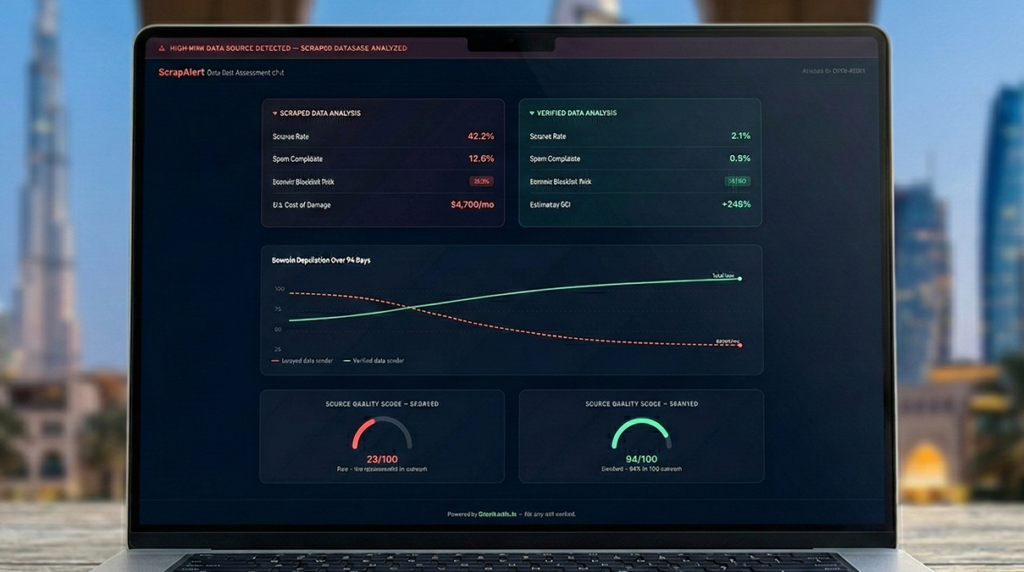
Google Maps scraping leads sounds like a shortcut — free business data, unlimited volume, no cost. But the hidden costs destroy more outreach campaigns than they help.
In addition, you downloaded a Google Maps scraper. Therefore, you pulled 10,000 “leads” in a single afternoon. Therefore, you loaded them into your cold email tool, hit send, and waited for meetings to roll in.
Instead, your bounce rate hit 47%. Accordingly, your domain got flagged. Accordingly, your sender reputation tanked. And three months later, you’re still trying to dig out of the hole you created in a single afternoon.
Sound familiar? You’re not alone. In Dubai’s competitive B2B market, Google Maps scraping has become the default “lead generation strategy” for agencies, SaaS companies, and service providers who want quick access to local business data. Additionally, the problem isn’t scraping itself — it’s what happens when you treat raw, unverified scrape data as a cold email list.
Automated scraping violates Google’s Terms of Service, putting your accounts and IPs at risk of permanent bans.
In fact, this article breaks down exactly why Google Maps scraping is sabotaging your outreach, what it actually costs you (with real math), and what to do instead if you want meetings, not spam complaints.
How Google Maps Scraping Leads Actually Works
Google Maps scraping exploded in the Dubai B2B space around 2022-2023. Tools like PhantomBuster, Outscraper, and dozens of Chrome extensions made it trivially easy to extract business listings by category and location. Search “restaurants in Business Bay,” click a button, get a spreadsheet with thousands of rows.
Furthermore, the appeal is obvious:
- It’s cheap. Most scraping tools cost AED 50-200/month. Evidently, some are free.
- It’s fast. You can pull thousands of records in minutes.
- It feels productive. A fat spreadsheet gives the illusion of a pipeline.
- It’s Dubai-specific. You can filter by emirate, neighborhood, and business category.
Here’s where everyone goes wrong: they confuse business directory data with outreach-ready leads. These are fundamentally different things. For example, a Google Maps listing tells you a business exists. Notably, it does not tell you who makes purchasing decisions, whether their contact details are current, or whether the email on file actually reaches a human being.
Furthermore, the Google Maps scraping leads boom has also created a saturation problem specific to Dubai. When every agency in JLT is scraping the same Google Maps categories, every restaurant owner in Dubai Marina has already received 50 cold emails this month from people using the exact same data source. Your message lands in a pile of identical-looking outreach — because it was generated from the identical source.
2. Specifically, what You Actually Get From a Google Maps Scrape
Let’s be specific about what a typical Google Maps scrape delivers when you target, say, “IT companies in Dubai”:
Google Maps Scraping Leads: Email Addresses Are Useless
Furthermore, the email field on Google Maps is the address the business owner entered when creating or claiming their listing. In practice, this means:
- 60-70% are generic addresses: info@, hello@, contact@, admin@, support@
- 10-15% are personal Gmail/Yahoo addresses: Often the founder’s personal email from 2018 that they no longer check
- 5-10% are dead: The domain expired, the business closed, or the email was changed
- 10-15% are actually usable: A real person’s work email that’s currently active
So out of 1,000 scraped records, roughly 100-150 give you a shot at reaching a decision-maker. Additionally, the other 850+ are going to bounce, hit a shared inbox that nobody reads, or get flagged as spam.
Phone numbers: reception lines
The phone numbers on Google Maps are typically the main business line — the number that rings at the front desk. In Dubai, this often means a receptionist who will politely take your message and never pass it along. For B2B outreach, you need direct lines or mobile numbers of decision-makers. Google Maps doesn’t have those.
Business information: outdated and incomplete
Google Maps listings in the UAE are notorious for stale data. Businesses in Dubai move offices frequently (especially in free zones), change trade names, or close without updating their listings. A 2024 analysis found that roughly 25-30% of Google Maps business listings in Dubai contain at least one outdated data point — wrong address, old phone number, or defunct email.
3. Additionally, the Hidden Costs: Bounce Rates, Spam Complaints, and Blacklisting
Here’s where the real damage happens. You scraped 5,000 “leads,” loaded them into Instantly or Smartlead, and started sending. Within 48 hours, three things happen simultaneously:
Bounce rates spike to 40-60%
Industry best practice for cold email is to keep your bounce rate under 3%. With raw Google Maps data, you’re looking at 40-60% bounces — that’s 13-20x the acceptable threshold. Every email service provider (ESP) and inbox provider tracks this metric. When you consistently send to addresses that don’t exist, the system flags your sending domain as a source of spam.
Spam complaints accumulate
The info@ addresses that do work? They’re typically monitored by administrative staff who never signed up for your email. In the UAE, businesses receive an enormous volume of unsolicited B2B email. The person reading info@company.ae has been trained to hit “Report Spam” without thinking. Specifically, each spam complaint is weighted heavily — Google considers a complaint rate above 0.1% to be problematic. With scraped data, you’ll blow past that threshold quickly.
IP and domain blacklisting
Once your bounce rates and complaint rates cross critical thresholds, your sending IP and/or domain end up on blacklists. Spamhaus, Barracuda, and SORBS are the big ones. Getting listed takes hours. Getting removed takes weeks — if you’re lucky. Some blacklists require a manual review process that can take 30+ days.
4. The Domain Reputation Death Spiral
In fact, this is the part that catches most people off guard. Domain reputation isn’t a switch that flips between “good” and “bad” — it’s a score that accumulates over time. And when it drops, it drops fast. Recovering is slow and painful.
Here’s how the death spiral works:
Week 1: You send 500 emails/day from your main domain using scraped Google Maps data. Your bounce rate is 45%. Your open rate is 8% (because most emails are landing in spam). You get 12 spam complaints.
Week 2: Gmail, Outlook, and Yahoo have all downgraded your sender reputation. Now even your emails to valid addresses are landing in spam. Your open rate drops to 3%. You’re effectively invisible.
Week 3: You realize something is wrong and stop the campaign. But the damage is done. Your domain is now associated with spam-like behavior in the algorithms of major inbox providers.
Weeks 4-12: You try to send legitimate emails — proposals to warm leads, follow-ups with existing clients, invoices. Indeed, many of these land in spam too, because your domain reputation affects all email from your domain, not just cold outreach.
The recovery timeline? With active reputation repair (warming, authentication fixes, clean sending), you’re looking at 6-12 weeks to restore your domain to healthy sending status. During that time, your entire email operation is compromised.
For a detailed walkthrough on protecting and repairing your domain reputation, read our Dubai email deliverability guide.
The worst part: many businesses don’t realize their domain is damaged. Consequently, they keep sending, keep bouncing, and keep digging the hole deeper. By the time they figure it out, they need to buy a new domain and start from scratch — losing all the authority and recognition their original domain had built.
5. A Real Cost Comparison: Scraped vs. Verified Leads
Let’s do the math that nobody in the scraping tool market wants you to do. We’ll compare two scenarios for a B2B service company targeting 500 IT firms in Dubai.
Scenario A: Google Maps scraping
| Cost Item | Amount |
|---|---|
| Scraping tool (monthly) | AED 150 |
| Records scraped | 5,000 |
| Valid emails after bounce (est. 55% bounce) | 2,250 |
| Decision-maker emails (est. 15% of valid) | 338 |
| Inbox placement rate (damaged reputation) | 40% |
| Emails actually seen by decision-makers | 135 |
| Reply rate on cold email (1.5% — low due to generic targeting) | 2 replies |
| Time spent cleaning data, troubleshooting deliverability | 8-12 hours |
| Domain reputation damage (cost of recovery/new domain) | AED 500-2,000 |
| Effective cost per reply | AED 400-1,075 |
Scenario B: Verified niche leads
| Cost Item | Amount |
|---|---|
| Verified lead list (500 decision-makers) | AED 450-900 |
| Valid emails (95%+ verified) | 475+ |
| Decision-maker emails | 475+ (all are decision-makers) |
| Inbox placement rate (clean reputation) | 85-92% |
| Emails actually seen by decision-makers | 404-437 |
| Reply rate on cold email (5-8% — higher due to niche targeting) | 20-35 replies |
| Time spent on data prep | 30 minutes |
| Domain reputation damage | AED 0 |
| Effective cost per reply | AED 13-45 |
The verified leads cost more upfront. The scraped leads cost 10-80x more per actual reply. And that’s before you factor in the opportunity cost of 8-12 hours of wasted time and 6-12 weeks of compromised email deliverability.
6. What “Verified” Actually Means — The Verification Process Explained
The word “verified” gets thrown around loosely in the lead generation industry. Some providers call a list “verified” if they ran it through a basic email syntax checker. That’s not verification — that’s a spell check.
Indeed, genuine lead verification is a multi-step process:
Step 1: Email existence check (SMTP verification)
The verification system connects to the recipient’s mail server and confirms the email address exists without actually sending an email. As a result, this catches typos, deactivated accounts, and non-existent mailboxes. Notably, it eliminates hard bounces.
Step 2: Catch-all detection
Admittedly, some domains are configured as “catch-all,” meaning they accept email to any address (anything@company.com will be received). Catch-all domains make it impossible to confirm whether a specific address is real. Good verification processes flag these separately so you can make informed decisions about whether to include them.
Step 3: Role-based email filtering
Addresses like info@, sales@, support@, and admin@ are role-based emails. They’re not tied to a specific person. They’re monitored by whoever happens to be on duty. For cold outreach, role-based emails produce significantly lower engagement and higher spam complaint rates. Proper verification flags and removes these.
Step 4: Decision-maker identification
In fact, this is where verification goes beyond email hygiene and into actual lead qualification. Identifying that mohammed@company.ae is Mohammed Al-Rashid, CEO, is a fundamentally different data point than knowing the email doesn’t bounce. As a result, this step typically involves cross-referencing with LinkedIn, company websites, corporate registries, and other sources.
Step 5: Freshness validation
Data decays. People change jobs. Companies close. In Dubai specifically, the turnover rate in certain sectors (hospitality, real estate, recruitment) is high. Verified data needs a freshness date, and reputable providers re-verify on a regular cycle — typically every 30-90 days.
For a deeper dive into cleaning and validating your existing lists, check our email list cleaning guide.
7. When Scraping Makes Sense vs. When It Doesn’t
To be clear: Google Maps scraping isn’t inherently bad. It’s a tool. The problem is using it for the wrong job.
When scraping makes sense
- Market sizing: Counting how many businesses exist in a given category and location. “How many dental clinics are in Dubai?” is a perfectly valid question that scraping answers well.
- Competitive analysis: Mapping the competitive landscape for a given niche. Understanding concentration, location patterns, and rating distributions.
- Initial research: Building a target account list (company names and categories) that you then enrich with verified contact data from other sources.
- Local SEO auditing: Analyzing your own or competitors’ Google Maps presence, reviews, and categories.
When scraping does NOT make sense
- Cold email campaigns: The data quality is too low, and the deliverability risks are too high.
- Cold calling campaigns: Reception lines don’t convert. You need direct numbers.
- Any outreach where volume = cost: If you’re paying per email sent (through your ESP), every bounce is money wasted.
- Anything where your domain reputation is at stake: Which is every email you send, ever.
The smart play: avoid Google Maps scraping leads for outreach. Importantly, use scraping for research, then source verified contact data separately. Treat them as two different steps in your process, not one.
8. How to Evaluate a Lead Provider’s Data Quality
If you’re going to buy leads instead of scraping them (and you should, for outreach), you need to know what separates a legitimate provider from someone who’s just reselling the same Google Maps scrape with a markup.
Ask these questions before you buy:
1. What’s your bounce rate guarantee?
Essentially, any provider worth working with will guarantee a bounce rate under 5%. Many will offer replacement credits for any bounces above their threshold. If a provider won’t commit to a bounce rate in writing, walk away.
2. How do you source your data?
“We scrape Google Maps and verify the emails” is not good enough. You want providers who use multiple data sources — corporate registries, LinkedIn, company websites, trade license databases, direct research — and cross-reference between them.
3. What percentage of emails are decision-maker contacts vs. generic/role-based?
If a provider can’t tell you this number, they haven’t done the work. Good providers should deliver 85%+ decision-maker emails (named individuals with job titles), not info@ addresses.
4. How often is the data refreshed?
Dubai’s business landscape changes fast. Data that was accurate 6 months ago could have 15-20% decay. Additionally, ask for the verification date. Prefer providers who re-verify at least quarterly.
5. Can you provide a sample before purchase?
Reputable providers will let you see a sample of the data format and quality. Additionally, run the sample through your own verification tool (ZeroBounce, NeverBounce, etc.) to confirm their claims.
6. Do your lists comply with UAE data protection regulations?
The UAE’s Federal Decree-Law No. 45 of 2021 on personal data protection has real implications for how B2B contact data is collected and used. Make sure your provider understands and complies with UAE cold email compliance requirements.
9. The DubaiLeads.io Approach: Niche-Specific, Pre-Verified, Decision-Maker Data
Additionally, we built DubaiLeads.io specifically because we were tired of the scrape-and-pray approach that dominates the Dubai market.
Here’s how our process works:
Niche-first data collection. We don’t scrape Google Maps and call it a day. Our lists are built around specific Dubai industries — real estate agencies, dental clinics, restaurants, IT companies, construction firms, and more. Each niche is researched individually, using multiple data sources including DED (Department of Economic Development) records, LinkedIn, company websites, and direct verification.
Decision-maker targeting. Every record includes the name, title, and direct email of the person who actually makes purchasing decisions. Not info@. Not the reception desk. The founder, the general manager, the marketing director — the person whose “yes” means a deal.
Multi-layer verification. Every email in our lists goes through SMTP verification, catch-all detection, role-based filtering, and freshness validation. Our target is less than 3% bounce rate, and we consistently deliver under that.
Dubai-specific data enrichment. We include data points that matter for UAE outreach: emirate, free zone vs. mainland, business activity codes, and company size indicators. As a result, this lets you personalize your outreach in ways that generic scraped data never could.
Regular refresh cycles. Our lists are re-verified regularly to account for the natural data decay in Dubai’s fast-moving business environment.
The result: you get a list you can load directly into your cold email tool, hit send with confidence, and actually get replies from people who have the authority to buy from you.
The Bottom Line
Google Maps scraping has its place — in market research, competitive analysis, and account identification. It does not have a place in your cold email workflow. The math doesn’t work. The deliverability risks are severe. And the opportunity cost of damaged sender reputation far exceeds whatever you saved on lead generation.
If you’re serious about B2B outreach in Dubai, move beyond Google Maps scraping leads and invest in verified, niche-specific, decision-maker data. Your reply rates, your domain reputation, and your revenue will reflect the difference.
Stop scraping. To begin with, start closing.
This article is part of our comprehensive B2B Lead Generation in Dubai: The 2026 Playbook — the complete guide to generating pipeline in the UAE market.