UAE Cold Email Laws: The Legal Landscape
UAE cold email laws carry penalties up to AED 10 million under TDRA regulations. Every B2B sender operating in the Emirates needs to understand these rules before pressing send.
If you’re sending B2B cold emails targeting companies in Dubai, Abu Dhabi, or anywhere in the UAE, you need to understand one thing clearly. Additionally, the Telecommunications and Digital Government Regulatory Authority (TDRA) has jurisdiction over electronic communications in this country. Consequently, they take unsolicited messages seriously.
Furthermore, the TDRA (formerly known as the TRA) is the federal body that governs telecommunications, digital infrastructure, and electronic communications across all seven emirates. When it comes to cold email, the TDRA operates under Federal Decree-Law No. 34 of 2021 on Combating Rumours and Cybercrimes, along with their own regulatory framework for unsolicited electronic communications.
Here is the critical distinction most B2B senders miss. Additionally, the UAE treats commercial email regulation differently depending on where your business is registered and where your recipient operates. For example, a company in mainland Dubai falls under TDRA federal regulations. A company in the Dubai International Financial Centre (DIFC) falls under its own data protection regime. A company in the Abu Dhabi Global Market (ADGM) has yet another framework. If you send from outside the UAE to recipients inside it, the TDRA regulations still cover you.
Furthermore, the TDRA (Telecommunications and Digital Government Regulatory Authority) is the primary regulator for electronic communications in the UAE.
Moreover, these UAE cold email laws catch many B2B senders off guard with their layered regulatory structure. Therefore, you cannot simply apply your home country’s email laws and assume compliance in the UAE.
TDRA Regulation on Unsolicited Electronic Communications (RUEC) — What It Says
Furthermore, the TDRA’s Regulation on Unsolicited Electronic Communications (RUEC) is the primary framework governing cold email in the UAE. Published and enforced by the TDRA, the RUEC defines unsolicited electronic communications as any commercial message that lacks prior consent from the recipient.
The key provisions you must understand:
- Prior consent requirement: The RUEC requires that senders obtain consent before sending commercial electronic messages. As a result, this applies to email, SMS, instant messaging, and automated voice calls.
- Sender identification: Every commercial email must clearly identify the sender, including the legal name of the business, a valid physical address in the UAE (or your registered jurisdiction), and accurate contact information.
- Opt-out mechanism: You must include a functional unsubscribe mechanism in every email. Process the opt-out within 10 business days (though best practice is immediate). For detailed guidance on setting up compliant opt-out mechanisms, read our email deliverability guide.
- Content accuracy: Subject lines and header information must not be misleading. In particular, no false sender names, deceptive subject lines, or misrepresented business identities.
- Record keeping: You must maintain records of consent, including when and how you obtained consent, for a minimum period as prescribed by the TDRA.
The B2B Exception Under RUEC
Notably, one area where the RUEC creates room for B2B senders: the regulation draws a distinction between messages sent to consumers (B2C) and messages sent to business contacts in their professional capacity (B2B). While explicit consent is always the safest route, B2B communications to publicly available business contacts have a slightly different risk profile than mass consumer marketing. In other words, that said, “slightly different” does not mean “no rules apply.”
Consent Requirements: Explicit vs. Implicit Consent Explained
In fact, this section is where most compliance failures begin. Understanding the difference between explicit and implicit consent is not optional — it determines whether your outreach is legal or whether you are exposed to regulatory action.
Explicit consent means the recipient has actively opted in to receive commercial communications from you. As a result, this includes:
- Filling out a form on your website and checking a consent box (pre-checked boxes do not count)
- Replying to an email confirming they want to receive your communications
- Verbally agreeing at an event, with a documented record
- Double opt-in email subscription
Implicit consent exists when there is a pre-existing business relationship or when the recipient’s contact information is publicly available in a business context. Examples include:
- A prospect who gave you their business card at a trade show (GITEX, Arabian Travel Market, etc.)
- A contact whose business email is listed on their company website’s “Contact Us” page
- Someone who has previously purchased from your company or engaged in business negotiations
- A professional whose details appear in a public business directory or industry listing
In the UAE’s B2B context, implicit consent from publicly available business information is commonly relied upon. However, you must still provide clear opt-out mechanisms, accurate sender identification, and relevant content. Sending bulk promotional email to scraped personal addresses does not qualify as legitimate B2B outreach under any interpretation.
The safest approach: treat implicit consent as a starting point, not a permanent permission. If a recipient does not engage after a reasonable sequence of 5-7 emails over 30 days, stop emailing them. If they opt out, process the removal immediately.
The AED 10 Million Penalty Structure
The financial penalties for non-compliance with UAE electronic communications regulations are not theoretical. Under Federal Decree-Law No. 34 of 2021, violations related to unsolicited electronic communications can result in fines of up to AED 10 million (approximately USD 2.72 million). Additional penalties may include:
- Imprisonment: Certain violations, particularly those involving fraud or identity misrepresentation, can carry prison sentences.
- Business license suspension: The TDRA can recommend that relevant authorities suspend or revoke a business license for repeat offenders.
- Equipment seizure: In severe cases, authorities can confiscate equipment used to send unsolicited communications.
- Blacklisting: UAE ISPs can add your domain and IP addresses to national blacklists, effectively killing your email deliverability across the entire country.
How Penalties Work in Practice
The penalty structure is tiered. A first-time violation with a small number of recipients and no deceptive content will be treated differently than a large-scale operation using spoofed sender information. But the TDRA does not need to prove financial harm — the act of sending unsolicited commercial messages without proper consent mechanisms is itself the violation.
In practice, most enforcement actions against B2B senders target companies sending high-volume unsolicited messages without unsubscribe options. Consequently, they also target those using purchased lists with no consent trail, or those misrepresenting their identity. If your outreach is targeted and professional, your risk profile is substantially lower. This means proper identification, opt-out, and legitimate business contacts.
Consequently, that said, “lower risk” is not “no risk.” Document your consent basis for every contact in your database.
DIFC Data Protection Law (for Dubai Free Zone Businesses)
If your business operates in the DIFC, or you email contacts at DIFC-registered companies, you face a separate legal framework. As a result, this is the DIFC Data Protection Law No. 5 of 2020 (as amended). Additionally, the DIFC has its own regulator — the Commissioner of Data Protection — and its own enforcement authority.
The DIFC Data Protection Law is modeled heavily on the EU’s GDPR. Key implications for B2B cold email:
- Lawful basis for processing: You need a lawful basis to process personal data (which includes business email addresses). The most relevant bases for B2B cold email are “legitimate interests” and “consent.”
- Legitimate interests assessment: Under DIFC law, you can rely on legitimate interests. Therefore, you must demonstrate that your interest in contacting the person does not override their rights. For B2B outreach to relevant decision-makers with a genuine business proposition, this is often defensible. You must document your assessment.
- Data subject rights: DIFC contacts have the right to access, correct, delete, and object to the processing of their personal data. An unsubscribe request is effectively an objection to processing, and you must honor it.
- Cross-border transfer restrictions: Transferring DIFC contact data outside the DIFC (including to mainland Dubai) requires adequate data protection measures.
- Breach notification: If your lead database is compromised, you must notify the Commissioner of Data Protection within 72 hours.
Fines under the DIFC framework can reach up to USD 100,000 per violation, with the Commissioner having discretion to increase penalties based on severity, duration, and the number of individuals affected.
ADGM Data Protection Regulations (for Abu Dhabi Free Zone Businesses)
The Abu Dhabi Global Market (ADGM) operates under its own Data Protection Regulations 2021, enforced by the ADGM Registration Authority and the Office of Data Protection. Like the DIFC framework, ADGM’s regulations are modeled on the GDPR.
For B2B email senders targeting ADGM-registered companies, the requirements are broadly similar to the DIFC framework:
- Lawful basis: You need a lawful basis for processing personal data, with legitimate interests being the most practical option for B2B cold email.
- Transparency: You must inform recipients about how you obtained their data, what you plan to do with it, and how they can opt out.
- Data minimization: Only collect and use the personal data that is necessary for your legitimate business purpose. If you only need a name, title, and business email, do not also store personal phone numbers, home addresses, or social media profiles.
- Accountability: You must be able to demonstrate compliance. This means written policies, documented consent records, and evidence of opt-out processing.
The ADGM framework allows fines of up to USD 28 million for serious violations, though penalties for B2B email compliance issues would typically fall far below this ceiling.
If you target both DIFC and ADGM companies in the same campaign, apply the stricter standard across your entire list. In practice, the requirements are similar enough that a single compliance framework covers both.
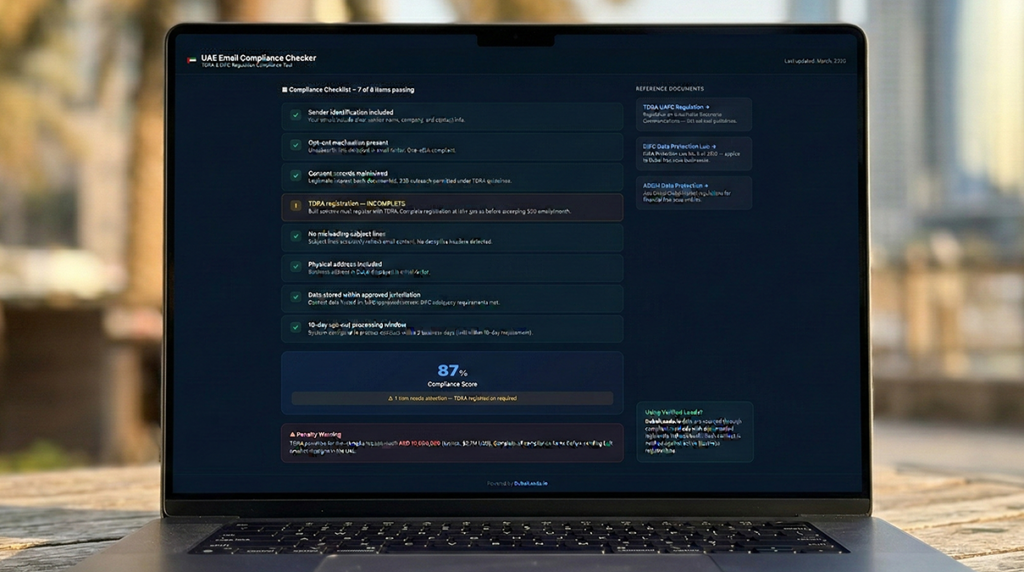
Practical Compliance Checklist (8 Items)
Use this checklist before sending any B2B cold email campaign in the UAE. Every item is non-negotiable.
1. Verify your consent basis for every contact. Document whether each contact falls under explicit consent, implicit consent (prior business relationship), or publicly available business information. If you cannot identify a consent basis, do not email that contact.
2. Include accurate sender identification in every email. Your “From” name must match a real person at your company. Accordingly, your business name, physical address, and registration details (trade license number or free zone registration number) must be accessible — either in the email footer or on a linked landing page.
3. Include a functional unsubscribe link in every email. The unsubscribe mechanism must work immediately. One-click unsubscribe is best. Never require recipients to log in, send a separate email, or complete a form to opt out. See our deliverability guide for technical setup instructions.
4. Use accurate, non-deceptive subject lines. Your subject line must relate to the content of your email. “RE:” or “FWD:” prefixes on first-touch emails are deceptive and violate UAE regulations. For compliant subject line examples, see our cold email templates.
Suppression Lists and Record Keeping
5. Process opt-out requests within 48 hours. The RUEC allows 10 business days, but best practice (and what major ESPs require) is immediate processing. Add a suppression list workflow to your CRM.
6. Maintain a master suppression list. Every opted-out contact must be added to a suppression list that is checked before every campaign send. This list must persist across campaigns, tools, and team members.
7. Limit your sending volume and frequency. No regulation specifies a maximum number of emails per day, but sending hundreds of unsolicited emails from a single domain in a short period signals spam behavior to both ISPs and regulators. Stay under 50 new contacts per day per sending domain during the first 4 weeks.
8. Keep records for a minimum of 2 years. Maintain records of: consent basis for each contact, email content sent, opt-out requests and processing dates, bounce data, and complaint data. If you are ever audited, these records are your defense.
How Other Countries Compare (CAN-SPAM, GDPR, CASL)
If you have run cold email campaigns in other markets, here is how the UAE framework compares:
CAN-SPAM (United States)
The US CAN-SPAM Act is the most permissive of the major frameworks. Notably, it does not require prior consent — you can email anyone as long as you include proper identification, an unsubscribe mechanism, and accurate headers. The UAE is stricter: it requires a consent basis (even if implicit consent from public business data is accepted for B2B). If you are used to CAN-SPAM rules, you need to tighten your compliance for UAE campaigns.
GDPR (European Union)
The GDPR requires a lawful basis for processing personal data, with legitimate interests being the most common basis for B2B cold email in Europe. The DIFC and ADGM frameworks are modeled on GDPR, so if you are already GDPR-compliant, your DIFC/ADGM compliance is likely in good shape. The federal TDRA framework has slightly different requirements, but a GDPR-compliant approach will generally satisfy TDRA standards as well.
CASL (Canada)
Canada’s Anti-Spam Legislation is the strictest major framework, requiring express consent (opt-in) for most commercial electronic messages. The UAE’s TDRA framework is less strict than CASL for B2B communications, as it accepts implicit consent from public business data. If you are CASL-compliant, you exceed UAE requirements.
The practical takeaway: if you build your UAE email compliance around GDPR’s legitimate interests framework, you will satisfy the DIFC, ADGM, and (with proper unsubscribe mechanisms) the federal TDRA requirements.
How Verified Lead Providers Help with Compliance
One of the biggest compliance risks in B2B cold email is using lead data with no documented source. Scraping contacts from the internet, buying lists from unverified vendors, or harvesting emails from social media leaves you with no way to prove legitimate consent if a regulator challenges you.
Verified lead providers like DubaiLeads.io address this problem in several ways:
- Documented sourcing: Verified providers maintain records of how each contact was sourced — typically from public business directories, company websites, trade show registrations, and official business registries. This creates a documented consent basis under the “publicly available business information” standard.
- Data accuracy: Verified leads have confirmed business email addresses, reducing bounce rates and spam complaints — both of which can trigger regulatory attention. A 15%+ bounce rate on cold email is a red flag for ISPs and regulators alike.
- Contact categorization: Quality providers categorize contacts by role, industry, and company type, allowing you to send genuinely relevant messages. “Relevant to the recipient’s professional interests” strengthens your legitimate interests argument under DIFC and ADGM frameworks.
- Suppression list integration: Reputable providers maintain their own suppression lists and check against them before delivering data. This means contacts who have previously opted out of commercial communications from other senders may already be excluded.
- Regular data refresh: Verified providers periodically re-verify their data, removing contacts who have changed roles, left companies, or had their emails deactivated. Stale data creates compliance risk because you may be emailing someone who no longer holds the position that justified your original consent basis.
What Verified Data Does Not Cover
Using a verified lead provider does not guarantee compliance — you still need proper unsubscribe mechanisms, accurate sender identification, and non-deceptive content. But it eliminates the single largest compliance vulnerability: the question of “where did you get my email?”
The Safe Way to Do B2B Cold Email in the UAE
Bringing it all together, here is the framework for complying with UAE cold email laws while running B2B campaigns in the UAE:
Step 1: Source your leads properly. Use verified lead providers or build your list from public business sources. Document the source of every contact. Never purchase lists from vendors who cannot explain their data sourcing methodology.
Step 2: Set up your technical infrastructure. Configure SPF, DKIM, and DMARC on your sending domain. Warm your domain gradually. Use a dedicated sending domain (not your primary business domain). See our email deliverability guide for the complete technical setup.
Step 3: Write compliant emails. Include your full sender identification. Use honest subject lines. Make your content relevant to the recipient’s professional role. Include a one-click unsubscribe link. See our compliant cold email templates for ready-to-use examples.
Volume Controls and Documentation
Step 4: Implement volume controls. Start with 10-20 emails per day from a new domain. Scale gradually over 4-6 weeks to a maximum of 50-75 per day. Never blast hundreds of emails in a single day from an unestablished domain.
Step 5: Monitor and respond. Track bounce rates (keep below 5%), complaint rates (keep below 0.1%), and opt-out rates. Process every opt-out immediately. Investigate any spam complaints.
Step 6: Document everything. Maintain records of your consent basis, sending history, opt-out processing, and compliance policies. If a regulator contacts you, your documentation is your first line of defense.
B2B cold email in the UAE is legal when done properly. The regulations exist to prevent spam and protect consumers, not to shut down legitimate business outreach. If you send relevant messages to appropriate business contacts, identify yourself honestly, and respect opt-out requests, you are operating well within the legal framework.
The companies that get into trouble are the ones sending thousands of unsolicited messages with no unsubscribe option, using fake sender names, and ignoring opt-out requests. Do not be that company.
Start with verified, properly sourced leads. Build your campaigns on a foundation of compliance. And when your results prove that quality outreach beats volume every time, you will never be tempted to cut corners again.
This article is part of our comprehensive B2B Lead Generation in Dubai: The 2026 Playbook — the complete guide to generating pipeline in the UAE market.