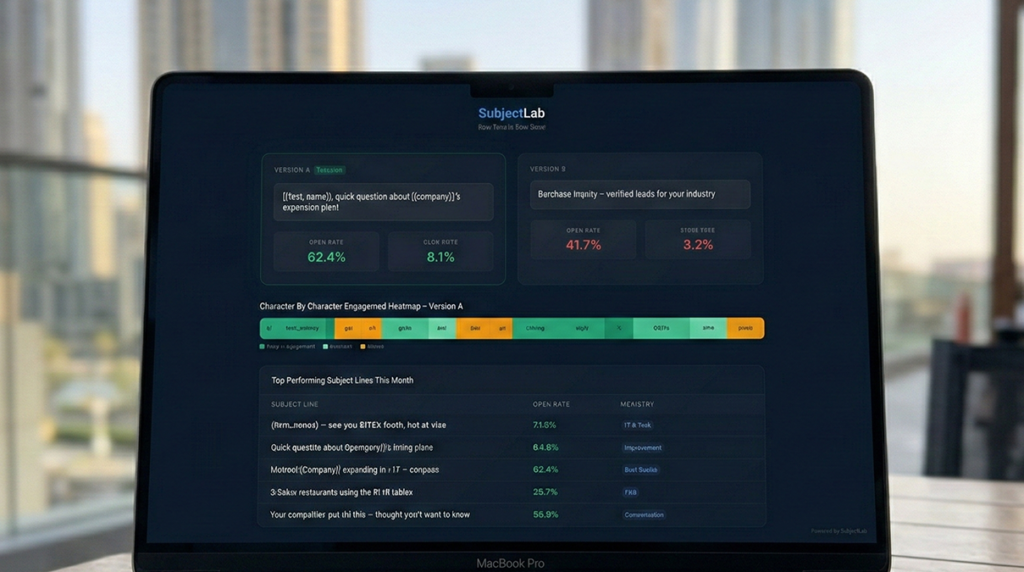
Moreover, these cold email templates B2B teams rely on have booked thousands of meetings across Dubai and the UAE. Every cold email template for B2B below is battle-tested in the Gulf market.
Cold Email Templates B2B: What Makes Them Work
Moreover, these cold email templates B2B teams actually use have booked thousands of meetings across Dubai and the UAE. Specifically, each one is battle-tested, not theoretical.
In addition, you have downloaded cold email templates before. Therefore, you pasted them into your outreach tool, swapped in a first name and company name, hit send, and got zero replies. In other words, that is not because cold email does not work. Notably, it is because most templates are built for the wrong market, written by people who have never sold anything in the Gulf, and designed to look impressive in a blog post rather than generate actual meetings.
Furthermore, the 10 templates in this guide are different for three specific reasons:
What Sets These Templates Apart
First, they are tested in the UAE market. Every template has been used in real campaigns targeting decision-makers at Dubai-based companies. Additionally, the language, references, and assumptions reflect the way business actually works in the GCC — not in San Francisco or London.
As Salesforce’s cold email guide confirms, personalization is the single biggest lever in B2B outreach response rates.
Second, they are short. The average cold email template for B2B that books a meeting in Dubai is 54-87 words. Not 200. Not 300. Every template in this guide is under 100 words in the body, because executives at DIFC firms and managing directors at DMCC companies do not read long emails from strangers. Consequently, they scan. Accordingly, your email needs to survive a 5-second scan and communicate value in that window.
Third, they have one CTA each. A cold email with two asks (“Would you be open to a call? Also, check out our case study”) converts at half the rate of a single, clear CTA. Each template ends with exactly one question or one request. In other words, that is it.
Copy these templates. Customize them for your specific offer and target audience. Send them to verified leads. Track your results. Then iterate your cold email templates B2B based on data, not gut feeling.
Template 1: The Referral Opener
In fact, this template leverages the power of mutual connections. In the UAE, where relationships drive 80% of business decisions, a warm referral — even a loose one — can increase your reply rate by 3-5x compared to a fully cold approach.
When to use it: When you share a mutual LinkedIn connection, attended the same event, or belong to the same industry group (Dubai Chamber, ABCD networking groups, specific free zone communities).
Subject: {{mutual_connection}} mentioned your name
Hi {{first_name}},
{{mutual_connection}} and I were discussing {{specific_topic}} last week, and your name came up. Consequently, they mentioned {{company_name}} is {{doing/exploring something specific}}.
Additionally, we recently helped {{similar_company}} {{achieve specific result}} — figured there might be overlap worth a quick conversation.
Would a 15-minute call on {{specific_day}} work?
Best,
{{your_name}}
Why it works: The mutual connection creates instant trust. Additionally, the specific result demonstrates capability without a lengthy pitch. Additionally, the proposed day (not “sometime this week”) makes it easy to say yes or suggest an alternative.
Customization notes: Always confirm with your mutual connection before using their name. In Dubai’s business community, word travels fast, and a fabricated referral will backfire spectacularly. If you cannot get explicit permission, use a softer version: “I noticed we both know {{mutual_connection}} through LinkedIn.”
Expected performance: 45-55% open rate, 12-18% reply rate with genuine mutual connections.
Template 2: The Pain Point Discovery
In fact, this template names a specific pain the recipient is likely experiencing, then offers to help without pitching your product. Notably, it works because it demonstrates understanding of their world, not your solution.
When to use it: When you have researched the prospect’s industry well enough to identify a genuine challenge they face. In Dubai, common B2B pain points include talent acquisition, lead generation costs, regulatory compliance, and cash flow management.
Subject: Struggling with {{specific_pain_point}}?
Hi {{first_name}},
I’ve been speaking with several {{job_title}}s in Dubai’s {{industry}} sector, and the same issue keeps coming up: {{describe pain point in one sentence}}.
{{Company_name}} looks like you might be dealing with this too, especially given {{specific_observation — recent hire, job posting, news, or website detail}}.
I have a few ideas that helped {{number}} similar companies reduce {{pain metric}} by {{percentage}}. Happy to share — no pitch, just the framework.
Worth a 10-minute chat?
{{your_name}}
Why it works: You are not selling. Therefore, you are offering insight. The “no pitch, just the framework” line disarms the natural resistance to cold emails. The specific observation proves you researched their business.
Customization notes: The specific observation is the make-or-break element. “I noticed you posted a job for a Business Development Manager on LinkedIn” is 10x more effective than “I noticed your company is growing.” Spend 2-3 minutes on LinkedIn and their website before sending.
Expected performance: 38-48% open rate, 8-14% reply rate.
Template 3: The Case Study Hook
In fact, this template leads with a result you achieved for a similar company. It is the most direct way to establish credibility with someone who has never heard of you.
When to use it: When you have a genuine case study or measurable result from a company in the same industry or market as the recipient. The more similar the case study company is to the prospect, the better this template performs.
Subject: How {{case_study_company}} {{achieved_result}}
Hi {{first_name}},
Additionally, we recently worked with {{case_study_company}} in {{location/free_zone}} to {{solve specific problem}}. In {{timeframe}}, they {{specific_measurable_result}}.
I looked at {{company_name}} and noticed a few similarities — particularly around {{shared_characteristic}}.
Would it be helpful if I shared the exact approach? Takes about 15 minutes to walk through.
{{your_name}}
Why it works: Specific results are more persuasive than promises. “Increased qualified leads by 340% in 90 days” says more about your capability than any amount of feature descriptions. The comparison to their company makes the result feel achievable, not abstract.
Customization notes: Use real numbers. “Increased revenue” is weak. “Increased monthly qualified leads from 12 to 53” is strong. If your case study company is well-known in Dubai (Emaar, Jumeirah Group, Mashreq Bank), lead with the name. If they are not well-known, lead with the result and mention the company as supporting context.
Expected performance: 40-50% open rate, 10-15% reply rate.
Template 4: The Industry Insight
This template positions you as someone with industry knowledge, not just a vendor. You share a relevant insight, trend, or data point, then connect it to their business.
When to use it: When you have a genuine insight about the prospect’s industry that they might not be aware of. As a result, this works particularly well during periods of regulatory change, market shifts, or after major industry events.
Subject: {{industry}} in Dubai is shifting — here’s what I’m seeing
Hi {{first_name}},
I’ve been tracking {{specific_trend}} across the {{industry}} sector in Dubai. {{One sentence describing the trend with a number or data point}}.
Companies like {{example_1}} and {{example_2}} are adapting by {{specific_action}}. I’m curious whether {{company_name}} has started thinking about this.
I put together a brief analysis — happy to send it over if useful.
{{your_name}}
Why it works: You are offering value before asking for anything. The CTA (“happy to send it over”) is low-commitment — they do not have to get on a call. They just have to reply. And once they reply, you are in a conversation.
Customization notes: The insight must be real. Do not fabricate trends. Pull data from reports by Dubai Chamber, DIFC, Dubai Economy, or industry-specific sources. If you reference a trend that the recipient knows is inaccurate, you lose all credibility instantly.
Expected performance: 35-45% open rate, 9-13% reply rate.
Template 5: The Direct Ask
Sometimes the most effective cold email is the simplest one. In particular, no storytelling, no case studies, no insights. Just a direct, honest question about whether they need what you sell.
When to use it: When you are targeting companies that clearly have the problem you solve. As a result, this template works best for commoditized services where the value proposition is widely understood — IT support, recruitment, cleaning services, marketing agencies.
Subject: Quick question, {{first_name}}
Hi {{first_name}},
I help {{industry}} companies in Dubai {{achieve specific outcome}}.
Is this something {{company_name}} is currently investing in, or are you handling it differently?
Either way, happy to share what we’re seeing work across the market.
{{your_name}}
Why it works: Brevity commands respect. As a result, this email takes 8 seconds to read. The question format invites a reply rather than a delete. The “either way” softener reduces pressure — even a “no” response starts a conversation you can build on.
Customization notes: The outcome must be specific. “Help companies grow” is useless. “Help IT companies in Dubai reduce cloud infrastructure costs by 20-35%” is compelling. Specificity is your credibility.
Expected performance: 42-50% open rate, 7-11% reply rate. Lower reply rate but higher quality replies — people who respond to direct asks are typically further along in their decision-making process.
Template 6: The Event Follow-Up (GITEX, Arab Health, Cityscape)
Dubai hosts some of the largest B2B events in the world. GITEX Global in October draws 180,000+ attendees. Arab Health in January is the largest healthcare exhibition in the Middle East. Cityscape in November is the region’s premier real estate event. These events create a natural warm context for outreach.
When to use it: Within 5-10 days after a major industry event. This template works whether or not you attended — the event serves as a shared context, not proof of a face-to-face meeting.
Subject: Post-{{event_name}} thought for {{company_name}}
Hi {{first_name}},
After {{event_name}}, I’ve been reflecting on {{key_theme or announcement from the event}}. It seems like the direction the {{industry}} is heading will require {{specific_capability or change}}.
Given {{company_name}}’s position in {{their_specific_niche}}, I thought you might find value in how we’re helping similar companies prepare for this shift.
Open to a brief call this week?
{{your_name}}
Why it works: The event reference creates shared context and timeliness. It makes the email feel relevant to something happening right now, not a random pitch. The forward-looking framing (“prepare for this shift”) positions you as a strategic partner rather than a vendor.
Customization notes: Reference a specific keynote, announcement, or theme from the event. “After GITEX, I noticed the strong focus on AI in enterprise operations” is far better than “After GITEX, I wanted to reach out.” Attendee lists are sometimes available through event organizers or published in trade media — use them to verify the prospect was there.
Expected performance: 43-52% open rate, 11-16% reply rate (when sent within 7 days of the event; drops by 30% after day 10).
Template 7: The Mutual Connection
Different from the Referral Opener (Template 1), this template uses a shared connection as context without implying a direct introduction. It is less aggressive and works for weaker ties — someone you both follow on LinkedIn, a common group membership, or a shared alma mater.
When to use it: When you have an indirect connection that does not warrant a full referral but still provides social proof.
Subject: We both know {{mutual_connection}} — quick intro
Hi {{first_name}},
I noticed we’re both connected with {{mutual_connection}} — small world in Dubai’s {{industry}} space.
I work with {{industry}} companies here to {{specific_outcome}}, and {{company_name}} caught my eye because {{specific_reason}}.
Would it make sense to connect for 10 minutes? If the timing is wrong, no worries at all.
{{your_name}}
Why it works: The “small world” framing plays into Dubai’s reality — the business community in any given sector here genuinely is small. The “no worries at all” exit clause makes it easy to decline without guilt, which paradoxically increases reply rates because it reduces the perceived commitment.
Customization notes: Choose a mutual connection who is well-known or well-respected in the industry. For example, a shared connection with 50 LinkedIn followers adds less social proof than one with 5,000. Use LinkedIn’s “Shared Connections” feature to find the strongest mutual ties.
Expected performance: 40-48% open rate, 9-14% reply rate.
Template 8: The Value-First Email
This template gives something valuable upfront — a resource, analysis, or tool — without asking for anything in return on the first email. The CTA is simply “want me to send it?” which generates a micro-commitment that you can build on in follow-ups.
When to use it: When you have a genuinely valuable resource to share — a market report, competitive analysis, template, or tool. Do not use this if your “value” is a product demo or sales deck.
Subject: Built this for {{industry}} companies in Dubai — yours free
Hi {{first_name}},
I put together a {{type_of_resource}} specifically for {{industry}} companies operating in the UAE. It covers {{2-3 specific things the resource addresses}}.
Figured it might be useful for {{company_name}}, especially given {{specific_observation about their situation}}.
Want me to send it over?
{{your_name}}
Why it works: Leading with generosity inverts the typical cold email dynamic. You are not asking — you are offering. The resource proves your expertise without you having to claim it. And once they reply “yes, send it,” you have started a dialogue that naturally leads to a conversation about their needs.
Customization notes: The resource must be genuinely useful and specific. A “Guide to B2B Sales in Dubai” is too broad. “2026 Salary Benchmarks for IT Professionals in DIFC” is specific enough to be irresistible to the right audience. Create the resource before you start the campaign. Do not promise something you have not built.
Expected performance: 38-46% open rate, 15-22% reply rate. The highest reply rate of any template in this list, though many replies are resource requests rather than meeting acceptances. The conversion to meeting happens on email 2 or 3.
Template 9: The Competitor Mention
This template references a competitor’s activity to create urgency and competitive awareness. It works because no business leader wants to be caught off guard by a competitor’s move.
When to use it: When you have verifiable information about a competitor’s activity — a new hire, product launch, marketing campaign, or strategic shift. Never fabricate competitor intelligence.
Subject: Noticed {{competitor_name}} is doing something interesting
Hi {{first_name}},
I came across something {{competitor_name}} recently launched — {{brief_description}}. Given that {{company_name}} operates in the same space, I thought it might be on your radar.
We’ve been helping companies in your position {{specific_outcome}} to stay ahead of these kinds of moves. Happy to share what we’re seeing if it’s useful.
Worth a quick call?
{{your_name}}
Why it works: Competitive intelligence is inherently valuable. Even if the recipient already knows about the competitor’s move, the fact that you are tracking it positions you as someone with market awareness. The framing is collaborative (“stay ahead”) rather than fear-based (“you’re falling behind”).
Customization notes: The competitor mention must be factual and publicly verifiable. Check press releases, LinkedIn announcements, or industry publications. In Dubai, sources like Zawya, Gulf Business, and Arabian Business cover competitive moves regularly. If you cannot verify it publicly, do not reference it — you risk looking like you are making things up.
Expected performance: 44-52% open rate, 10-15% reply rate.
Template 10: The Breakup Email
Furthermore, the final email in your sequence. It signals that you are about to stop reaching out, which triggers loss aversion — the psychological principle that people value avoiding a loss more than acquiring an equivalent gain.
When to use it: As the fourth or fifth email in a sequence, after 2-3 previous attempts have gone unanswered. This is your last shot.
For the full framework on what comes after the first email — timing, sequence structure, and optimal follow-up count — read our cold email follow-up sequence guide.
Subject: Should I close your file, {{first_name}}?
Hi {{first_name}},
I’ve reached out a few times about {{topic}} and haven’t heard back — which is completely fine. You’re busy.
I don’t want to keep cluttering your inbox, so I’ll assume the timing isn’t right and close your file on our end.
If anything changes, feel free to reply to this thread anytime. I’ll be here.
All the best,
{{your_name}}
Why it works: The “close your file” framing creates a sense of finality that triggers a response. Research shows breakup emails generate 2-3x the reply rate of standard follow-ups because the perceived withdrawal of attention is psychologically motivating. The tone is gracious, not guilt-tripping, which preserves the relationship for potential future outreach.
Customization notes: Do not fake it. If you say this is your last email, make it your last email. Sending another “one more thing” email after a breakup email destroys all credibility. Also, keep the door open genuinely — some of the best meetings I have booked from Dubai outreach came 3-6 months after a breakup email, when the prospect’s circumstances changed.
Expected performance: 45-55% open rate, 8-12% reply rate. Many replies are “not now but keep me in mind,” which is a valid outcome — you can re-engage in 3-6 months with a fresh sequence.
How to Personalize Templates for the UAE Market (Cultural Considerations)
Cold email works differently in the UAE than in the US, UK, or Europe. Cultural norms shape how your outreach is received, and ignoring them is a fast path to low reply rates or, worse, damaging your reputation in a market where word travels fast.
Formality levels vary by nationality
Dubai’s business population is extraordinarily diverse. Accordingly, your prospect’s cultural background affects their communication preferences:
- Emirati decision-makers: Lead with respect and formality. Use full names (not just first names) on the first email. Avoid overly casual language. Reference shared values or community connections where possible.
- South Asian executives (Indian, Pakistani): Warm and relationship-oriented. Titles matter — use “Mr.,” “Dr.,” or professional designations. Referral-based templates perform exceptionally well.
- Western expats (British, American, European): More comfortable with direct, informal approaches. First-name basis is generally fine. Pain-point and direct-ask templates perform well.
- Arab expats (Lebanese, Egyptian, Jordanian): Business is personal. Social proof and mutual connection templates are most effective. Expect longer sales cycles and more relationship-building before decisions.
Timing matters — both daily and annually
Furthermore, the UAE business week runs Sunday through Thursday (though some private companies now operate Monday-Friday). Government entities and many established businesses follow the Sun-Thu schedule. Check your prospect’s company before scheduling sends.
- Best send times: Tuesday through Thursday, 9:00-10:30 AM Gulf Standard Time (GST). Monday/Sunday mornings have inbox overload from the weekend. Thursday afternoons see declining engagement as the weekend approaches.
- Ramadan: Business slows significantly. Shorten your emails further. Avoid hard sells. Acknowledge the holy month if contextually appropriate. Many meetings shift to the evening during Ramadan (after Iftar). Plan your campaigns around this — reduce volume by 40-50% during Ramadan and increase after Eid Al Fitr.
- Summer (June-August): Many decision-makers leave Dubai for cooler climates. Open rates drop 15-25% in July and August. Front-load your Q3 campaigns in September.
Compliance is non-negotiable
The UAE’s Telecommunications and Digital Government Regulatory Authority (TDRA) has regulations governing commercial electronic messages. While enforcement is evolving, you should be aware of your obligations. Our UAE cold email compliance guide covers the legal framework in detail. At minimum: always include an unsubscribe option, use accurate sender information, and never send to recipients who have previously opted out.
Language considerations
English is the dominant business language in Dubai, but it is not everyone’s first language. Write at a Grade 8 reading level. Avoid idioms, slang, and culturally specific references. “Let’s circle back” or “boil the ocean” might confuse non-native English speakers. Say what you mean plainly.
The Anatomy of a Perfect Cold Email (Breakdown)
Indeed, every template above follows the same underlying structure. Understanding this anatomy lets you create your own templates from scratch, customize existing ones more effectively, and diagnose why a failing email is not working.
Element 1: Subject Line (3-7 words)
Specifically, your subject line must accomplish one thing: get the email opened. It does not need to explain your offer, establish credibility, or ask for a meeting. Those are the body’s job. For 47 tested subject lines you can use today, read our complete subject line guide.
Rules:
- Under 60 characters (to avoid truncation on mobile)
- Activate one of the four triggers: curiosity, relevance, urgency, or social proof
- No spam trigger words (free, guarantee, exclusive, act now)
- Lowercase first word (unless a proper noun) — mimics personal email style
Element 2: Opening Line (1 sentence, under 20 words)
Specifically, your opening line must prove you are not sending a mass blast. It should reference something specific to the recipient: their company, a recent event, a mutual connection, a job posting, or an observation from their website or LinkedIn.
Examples of strong opening lines:
- “I noticed {{company_name}} just opened a second office in Abu Dhabi — congratulations.”
- “Your recent LinkedIn article on {{topic}} landed differently than most content I see from {{industry}} leaders.”
- “{{mutual_connection}} mentioned you’re rethinking your approach to {{specific_process}}.”
Examples of weak opening lines:
- “I hope this email finds you well.” (Meaningless filler)
- “My name is [name] and I’m the CEO of [company].” (Nobody cares who you are yet)
- “I came across your company online.” (Vague and generic)
Element 3: Value Proposition (2-3 sentences)
This is the core of your email. In 2-3 sentences, communicate what you do, who you do it for, and what result you deliver. No feature lists. No company history. Just the outcome.
Framework: “We help [specific_audience] [achieve_specific_outcome]. [One sentence of proof or context].”
Example: “We help IT services companies in Dubai generate 30-50 qualified meetings per month through targeted outbound. Last quarter, we booked 147 meetings for three clients in your space.”
Element 4: CTA (1 sentence, 1 ask)
Your CTA asks for exactly one thing. Not two. Not a choice between two options. One clear, low-friction ask.
Strong CTAs:
- “Would a 15-minute call on Tuesday or Wednesday work?”
- “Want me to send over the analysis?”
- “Is this worth exploring for {{company_name}}?”
Weak CTAs:
- “Let me know if you’d like to chat or feel free to check out our website for more info.” (Two asks, both vague)
- “Would you be available for a call at your earliest convenience?” (No specificity, no urgency)
- “I’d love to set up a demo to walk you through our full suite of solutions.” (Too much commitment for a cold email)
Element 5: Signature (Clean, minimal)
Your signature should include your name, title, company, and one contact method (phone or LinkedIn). That is it. No logos, no banners, no inspirational quotes, no 8 social media links. Heavy signatures increase spam classification probability because they contain excessive HTML and links.
Putting it all together
The total structure looks like this:
- Subject line: 3-7 words, one psychological trigger
- Opening line: 1 sentence, prospect-specific
- Value proposition: 2-3 sentences, outcome-focused
- CTA: 1 sentence, one clear ask
- Signature: Name, title, company, one link
Total word count: 54-87 words in the body. That is the target range for cold emails that book meetings in Dubai. If you are over 100 words, you are writing too much. Cut ruthlessly until every word earns its place.
These 10 templates give you a starting framework. But a template without the right data behind it is just a well-formatted email to nobody. The leads you send to determine whether these templates generate meetings or bounce notifications. Verified, current, role-specific contact data is the difference between a campaign that produces pipeline and one that burns your domain.
This article is part of our comprehensive B2B Lead Generation in Dubai: The 2026 Playbook — the complete guide to generating pipeline in the UAE market.