Indeed, niche leads consistently outperform generic databases by 10-15x on every metric that matters — reply rates, meetings booked, and revenue per send.
In addition, you bought 50,000 “UAE business contacts” from a bulk data provider. Without niche leads, the price per lead was unbelievably low — maybe AED 0.02 per contact. Therefore, you felt like you’d struck gold.
Then you ran the campaign. Out of 50,000 contacts, 22,000 bounced. Of the 28,000 that delivered, 8,400 landed in spam. Among the 19,600 that reached an inbox, 588 were opened (3% open rate — your deliverability was already shot). Of those 588, you got 4 replies. Two of them were “Remove me from your list.”
Meanwhile, your competitor bought 500 verified leads targeting dental clinic owners in Dubai. Consequently, they spent 10x more per lead. As a result, they got 47 replies and booked 12 meetings. Using niche leads, they closed 3 deals worth AED 180,000 in total.
According to the Dubai Department of Economy and Tourism, Dubai has over 372,000 registered businesses across dozens of industries.
In fact, this isn’t a hypothetical. As a result, this is the niche leads math that plays out every day in Dubai’s B2B market. And by the end of this article, you’ll understand exactly why 500 niche leads outperform 50,000 generic contacts — with the numbers to prove it.
The Math Behind Niche Leads vs. Generic Databases
Furthermore, the bulk data trap is seductive because it appeals to a basic human instinct: more must be better. If 1,000 leads might produce 10 meetings, then 50,000 leads should produce 500 meetings, right?
Wrong. Additionally, the relationship between niche leads volume and results is not linear. In reality, it’s logarithmic at best, and often inverse — because sending to massive, low-quality lists actively damages your ability to reach anyone.
Why businesses keep falling for it:
- The per-unit cost looks incredible. “50,000 contacts for AED 999” sounds like a bargain. You’re not thinking about cost per reply or cost per meeting — you’re anchored on cost per record.
- There’s a comfort in volume. Having a massive database feels like having a safety net. “Even if only 1% convert, that’s still 500 leads.” Except 1% of 50,000 contacts never convert when 44% of the emails bounce.
- It’s the default offering. In fact, most lead providers in the UAE sell by volume because it’s easier to charge more for bigger numbers. They have no incentive to tell you that 90% of their data is worthless for outreach.
- The real costs are hidden. Meanwhile, bounce rates, domain damage, spam complaints, wasted sending credits, and lost time don’t show up on the invoice. They show up 3-6 weeks later when your email stops working.
For a detailed breakdown of what happens when you use low-quality scraped data for outreach, read our analysis of Google Maps scraping vs. verified leads.
2. Additionally, the Conversion Math (Worked Example With Real Numbers)
To illustrate, let’s walk through two complete scenarios with realistic numbers for Dubai B2B outreach. We’ll track every step from list to closed deal.
Scenario A: 50,000 Generic Contacts vs. Niche Leads
| Metric | Number |
|---|---|
| Total contacts purchased | 50,000 |
| Cost of list | AED 999 |
| Bounce rate (typical for bulk lists) | 44% |
| Emails delivered | 28,000 |
| Spam/promotions folder (est. 30% due to reputation damage) | 8,400 |
| Emails in inbox | 19,600 |
| Open rate (low due to generic targeting + reputation) | 3% |
| Emails opened | 588 |
| Reply rate | 0.7% |
| Replies (total) | 4 |
| Positive replies (est. 50%) | 2 |
| Meetings booked (est. 50% of positive replies) | 1 |
| Sending tool costs (50k emails across warmup domains) | AED 750 |
| Time spent managing campaign, troubleshooting bounces | 20+ hours |
| Domain reputation recovery costs | AED 500-2,000 |
| Total cost | AED 2,249-3,749 |
| Cost per meeting | AED 2,249-3,749 |
Scenario B: 500 niche, verified leads
| Metric | Number |
|---|---|
| Total contacts purchased | 500 |
| Cost of list | AED 500 |
| Bounce rate (verified list) | 2% |
| Emails delivered | 490 |
| Spam/promotions folder (low — clean reputation) | 49 (10%) |
| Emails in inbox | 441 |
| Open rate (high due to niche relevance + clean reputation) | 55% |
| Emails opened | 243 |
| Reply rate (niche targeting + personalization) | 8% |
| Replies (total) | 19 |
| Positive replies (est. 63%) | 12 |
| Meetings booked (est. 75% of positive replies) | 9 |
| Sending tool costs (500 emails, single domain) | AED 100 |
| Time spent managing campaign | 3 hours |
| Domain reputation damage | AED 0 |
| Total cost | AED 600 |
| Cost per meeting | AED 67 |
The comparison: 500 niche leads produced 9x more meetings at 1/33rd to 1/56th the cost per meeting. Additionally, the generic list produced 1 meeting for AED 2,249-3,749. The niche list produced 9 meetings for AED 67 each.
Furthermore, the generic list left behind a trail of domain damage that will take weeks to recover from, while the niche list left the sender reputation intact for the next campaign.
3. Message-Market Fit: Why Niche Targeting 10x Your Response Rates
In cold email, response rate is driven by one thing above all else: relevance. When your message speaks directly to a specific person’s specific problem in their specific industry, they respond. When your message is a generic “we help businesses grow,” they delete.
In essence, niche targeting enables relevance at every layer:
Subject line relevance
Generic: “Grow Your Business With Our Services”
Niche: “3 Walk-In Patients/Month for Your JBR Dental Clinic”
Furthermore, the niche subject line tells the recipient in 8 words that you understand their industry (dental), their location (JBR), their business model (walk-ins), and their goal (growth). By contrast, the generic subject line tells them nothing.
Problem specificity
Generic: “Many businesses struggle with lead generation.”
Niche: “Most dental clinics in Dubai rely on Google Ads and Zocdoc, but the cost per acquisition has jumped 40% since 2024. Accordingly, your competitors in Business Bay and Marina are already switching to direct outreach.”
Furthermore, the niche version demonstrates that you understand their competitive landscape, their current marketing channels, and the specific economic pressure they’re facing. It’s impossible to write this kind of copy when you’re emailing 50,000 random businesses.
Social proof alignment
Generic: “We’ve helped over 200 businesses.”
Niche: “We help 3 dental clinics in your area generate 15+ new patient inquiries per month.”
Importantly, social proof only works when the recipient can see themselves in it. For example, a dental clinic owner doesn’t care that you’ve helped “200 businesses.” Instead, they care that you’ve helped dental clinics like theirs.
4. Dubai Industry Spotlights: Real Estate, Restaurants, Dental, Construction, IT
Here’s how niche targeting plays out in Dubai’s most active B2B industries. Specifically, each example shows why industry-specific data and messaging dramatically outperform generic outreach.
Real estate agencies
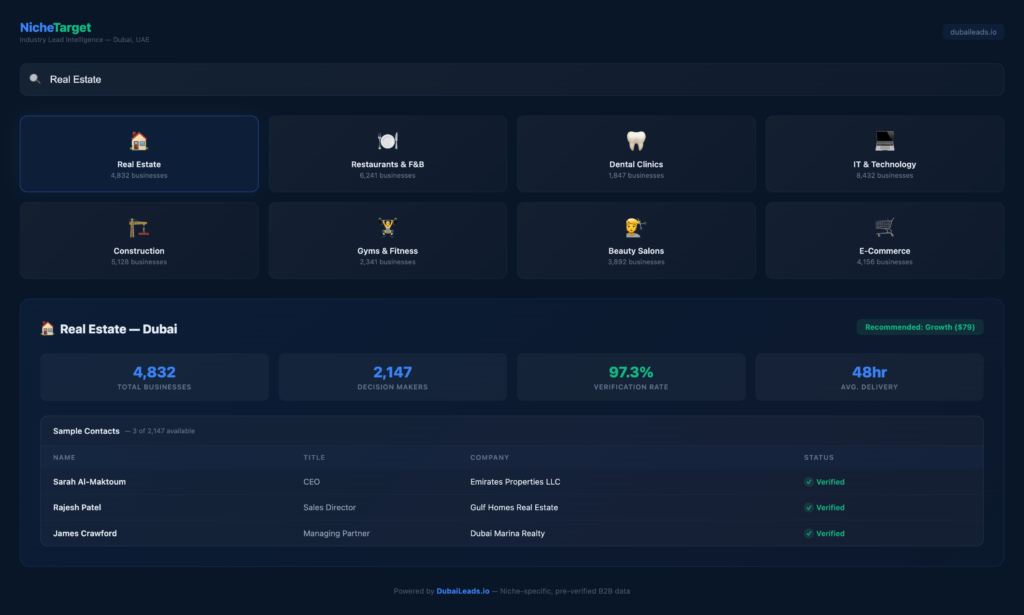
Notably, Dubai has over 5,000 registered real estate brokerages. In fact, most are small operations (2-10 agents) with a single decision-maker. Moreover, the industry has specific pain points: RERA compliance, off-plan project marketing, lead generation from foreign investors, and property management technology.
What niche data gives you: Agency name, brokerage license number, principal broker name and direct email, specialization (residential vs. commercial, off-plan vs. secondary market), areas of focus (Downtown, Marina, Palm, etc.), agency size.
Why it matters: A cold email to a residential brokerage in Palm Jumeirah about off-plan lead generation is relevant. The same email sent to a commercial warehouse leasing company in Jebel Ali is noise.
Restaurants and F&B
Similarly, Dubai’s restaurant industry is fiercely competitive, with over 13,000 licensed food establishments. The decision-maker is typically the owner, general manager, or operations director. Key pain points: food cost management, delivery platform commissions (30%+ on Talabat/Deliveroo), staff turnover, and customer acquisition.
What niche data gives you: Restaurant name, cuisine type, location, owner/GM name and direct email, number of outlets, licensing type (restaurant, cafe, catering, cloud kitchen).
Why it matters: A cloud kitchen operator in Al Quoz has completely different needs than a fine dining restaurant in DIFC. Niche data lets you segment and personalize accordingly.
Dental clinics
Dubai has approximately 1,200+ licensed dental facilities, ranging from single-practitioner clinics to multi-location chains. Typically, decision-makers are the clinic owner (often a dentist themselves), practice manager, or medical director. Pain points: patient acquisition cost, insurance panel management, equipment financing, and regulatory compliance with DHA.
What niche data gives you: Clinic name, DHA license number, managing dentist name and direct email, location, specializations offered, number of chairs/practitioners.
Why it matters: You can reference DHA regulations, patient acquisition costs specific to dental, and competitive dynamics in their specific area. Try doing that with a generic “healthcare companies” list.
Construction and contracting
Dubai’s construction sector includes over 8,000 licensed contractors. Notably, the hierarchy is steep — the person who signs contracts is usually the managing director or projects director, not the info@ inbox. Pain points: project pipeline visibility, subcontractor management, payment cycles (90-120 days is common in UAE construction), and material cost volatility.
What niche data gives you: Company name, trade license category (main contractor, subcontractor, specialist), classification grade (1-5 in Abu Dhabi, or unlimited in Dubai), director name and direct email, project types (residential, commercial, infrastructure).
IT and technology companies
Dubai’s tech ecosystem spans from two-person development shops to regional offices of global enterprises. There are approximately 4,000+ IT-related companies in Dubai, many clustered in Dubai Internet City, Dubai Silicon Oasis, and DMCC. Decision-makers: managing director, CTO, or head of business development. Pain points: talent acquisition, project pipeline, partnership opportunities, and cloud migration services.
What niche data gives you: Company name, specialization (development, consulting, cybersecurity, cloud, SaaS), free zone affiliation, key decision-maker name and direct email, company size, technology stack (when available).
For more Dubai industry insights and lead generation strategies by sector, see our B2B lead generation Dubai guide.
5. How to Identify Your Ideal Customer Profile Before Buying Leads
Before you spend a dirham on leads, you need absolute clarity on who you’re targeting. Importantly, an Ideal Customer Profile (ICP) isn’t a vague description — it’s a specific, measurable set of criteria that define which businesses are most likely to buy from you.
The ICP framework for Dubai B2B:
1. Industry vertical: Not just “real estate” but “residential real estate brokerages focused on off-plan properties in new developments.” The tighter, the better.
2. Company size: In Dubai, company size is often measured by employee count, number of outlets (for F&B/retail), or annual revenue. Determine the minimum and maximum size of companies that are a good fit for your offer. A 3-person startup and a 500-person enterprise have fundamentally different needs and budgets.
3. Location: Emirate, free zone vs. mainland, and even specific area matter in the UAE. A company in DIFC has a different profile (and different spending power) than a company in Sharjah’s industrial area.
4. Decision-maker role: Who signs the check? In smaller Dubai businesses (under 20 employees), it’s almost always the owner or managing director. In larger companies, it might be a department head. Define the role you need to reach.
5. Technology signals: What tools do they use? If you’re selling marketing software, targeting businesses that already use HubSpot or Salesforce tells you they have budget and sophistication. These signals are harder to find but extremely valuable for targeting.
6. Business maturity: A company established in 2024 has different needs than one operating since 2010. In Dubai, you can check establishment dates through DED records.
Practical exercise:
To start, look at your last 10 closed deals. Specifically, what did those customers have in common? Industry, size, location, decision-maker title, pain point that triggered the purchase. Write those commonalities down. That’s your ICP. Now buy leads that match exactly those criteria — not a broader list that includes those criteria alongside 49,500 irrelevant contacts.
6. The Cost-Per-Meeting Calculation: Niche vs. Generic
Ultimately, cost per meeting is the metric that makes the niche vs. generic debate obvious. Here’s a simplified formula and comparison across different lead price points.
Formula:
Cost Per Meeting = (Lead List Cost + Sending Tool Cost + Time Cost) / Number of Meetings Booked
Generic leads at different price points:
| List Size | List Cost | Est. Meetings | All-In Cost | Cost/Meeting |
|---|---|---|---|---|
| 10,000 | AED 200 | 0-1 | AED 900 | AED 900+ |
| 25,000 | AED 500 | 1-2 | AED 2,100 | AED 1,050-2,100 |
| 50,000 | AED 999 | 1-3 | AED 3,749 | AED 1,250-3,749 |
Niche, verified leads at different price points:
| List Size | List Cost | Est. Meetings | All-In Cost | Cost/Meeting |
|---|---|---|---|---|
| 200 | AED 250 | 3-4 | AED 370 | AED 93-123 |
| 500 | AED 500 | 7-12 | AED 650 | AED 54-93 |
| 1,000 | AED 900 | 15-25 | AED 1,100 | AED 44-73 |
The niche cost per meeting is 10-50x lower. And unlike the generic approach, your domain reputation stays intact, so you can run the next campaign without rebuilding.
7. Building a Niche Outreach Campaign From Scratch
Here’s the step-by-step process for running a niche cold email campaign in Dubai that actually produces meetings.
Step 1: Define your ICP (30 minutes)
Use the framework from Section 5. Be specific. “IT companies in Dubai” is too broad. “IT consulting firms in Dubai Internet City with 10-50 employees that serve enterprise clients” is an ICP.
Step 2: Source verified, niche-specific leads (1-2 days)
Buy a list that matches your ICP exactly. Every contact should be a named decision-maker with a verified direct email. Therefore, you want 200-500 leads for your first campaign — enough to generate statistically meaningful data, small enough to personalize effectively.
Step 3: Segment your list (1 hour)
However, even within a niche, you should create 2-3 segments based on relevant differences. For IT consulting firms, you might segment by: size (10-20 employees vs. 21-50), specialization (cloud vs. cybersecurity vs. general consulting), or location (Internet City vs. Silicon Oasis). Each segment gets slightly different messaging.
Step 4: Write personalized email sequences (2-3 hours)
Write a 3-email sequence for each segment. Accordingly, your first email should:
- Reference something specific about their industry or situation
- Articulate a specific problem they face (not a generic pain point)
- Offer a specific, relevant result (with a number)
- Include a clear, low-friction call to action (15-minute call, not “let’s discuss synergies”)
Crucially, follow-up emails should add new information, not just repeat the first email. Share a case study, a relevant data point, or a different angle on the same problem.
Step 5: Set up your sending infrastructure (2-3 hours one-time)
Configure SPF, DKIM, and DMARC on your sending domain. Warm up the domain for 2-3 weeks if it’s new. Additionally, set your sending tool to 30-50 emails per day per mailbox. Importantly, use 2-3 mailboxes to distribute sending load.
Step 6: Launch and monitor (ongoing)
Send Monday through Thursday (Sunday through Wednesday also works well in the UAE, since the business week starts on Sunday for many companies). Monitor bounce rates, open rates, and reply rates daily for the first week. Adjust subject lines if open rates are below 40%. Adjust messaging if reply rates are below 3%.
Step 7: Work your replies (ongoing)
In fact, this is where the value of niche targeting really shows. When a dental clinic owner replies to your email, you already know their industry, their likely pain points, and what success looks like for them. The sales conversation starts at a much higher level than “So, tell me about your business.”
8. Case for Niche: Cultural and Language Precision in UAE’s Diverse Market
Dubai is one of the most culturally diverse business markets on earth. In fact, over 200 nationalities live and work here. Naturally, the language of business shifts based on industry, company origin, and individual background. As a result, this diversity makes niche targeting even more valuable — and makes generic outreach even more likely to miss.
Language considerations by industry
Real estate: Business communication happens in English, Arabic, Russian, Chinese, and Hindi — depending on the target investor market the brokerage serves. A brokerage targeting Russian investors in Palm Jumeirah operates differently from one targeting Emirati families in Al Barsha. Niche data that includes the brokerage’s market focus lets you match your language and approach.
Construction: The decision-makers (managing directors, project directors) typically communicate in English or Arabic. Technical specifications are in English. But many subcontractor relationships operate in Hindi, Urdu, or Tagalog. Understanding the communication hierarchy matters when you’re deciding who to email and how to write.
F&B: Owner-operators come from every background. A Filipino restaurant owner in Karama has a different communication style than a French chef-owner in DIFC. Niche data that identifies the establishment type and location helps you calibrate your tone and language.
Cultural timing
Specifically, your campaign timing should respect cultural realities that vary by audience:
- Ramadan: Business hours shift. Email engagement drops in the afternoon. Morning sends (before 10 AM) perform best. Evidently, some industries slow down significantly; others (F&B, particularly iftar catering) peak.
- Friday: The traditional day of rest. Government entities and many traditional businesses are closed. Free zone companies and multinational operations often work a half day. For many businesses, Sunday is the start of the working week.
- Summer (June-September): Many business owners and decision-makers travel during the hottest months. Response rates typically dip 15-25%. Campaigns targeting industries with year-round operations (hospitality, healthcare, essential services) are less affected.
- Q4 (October-December): Peak business season in Dubai. Companies are finalizing budgets for the next year. As a result, this is prime time for B2B outreach — response rates and deal velocity are highest.
The personalization advantage
When you know your niche, you can personalize at a level that generic outreach can never match. You can reference specific regulatory changes (DHA for healthcare, RERA for real estate, MOHRE for recruitment). You can name competitors they’ll recognize. Moreover, you can cite market trends they’re living through. It becomes possible to use industry terminology that signals you’re an insider, not a random spammer.
In fact, this level of personalization is what separates a 2% reply rate from a 10% reply rate. And it’s only possible with niche leads — when your list is tight enough that you can deeply understand every recipient’s world.
The Bottom Line
The math doesn’t lie. 500 niche leads consistently outperform 50,000 generic contacts on every metric that matters: reply rate, cost per meeting, deal velocity, and sender reputation protection.
Admittedly, the bulk data trap persists because it feels intuitive — bigger list, more chances. But cold email doesn’t work on pure probability. Notably, it works on relevance. And relevance requires knowing exactly who you’re talking to, what they care about, and what problem you can solve for them.
Accordingly, stop buying volume. To begin with, start buying precision. Your pipeline — and your email domain — will thank you.